Morning Five: 09.12.12 Edition

Posted by rtmsf on September 12th, 2012

  1. Another day, another scandal involving the, ahem, good name of college basketball. With all the allegations getting tossed around the sport in recent months, we’re starting to wonder if the best course of action is simply to burn the whole thing down and start completely over. After Tuesday’s disappointing news that even the nation’s top academic institution, Harvard, isn’t immune from student-athletes behaving badly, you’ll forgive us if we’re feeling a little more than down about our game. The skinny: SI.com’s Luke Winn has reported that senior co-captains Kyle Casey and Brandyn Curry — two of the Crimson’s best three players — have been implicated in a cheating scandal along with over a 100 other students for acts in a class about Congress “ranging from inappropriate collaboration to outright plagiarism, on a take-home final exam.” With the fall semester enrollment deadline pending this week, Casey and Curry are expected to withdraw from school for the entire 2012-13 academic year in an effort to preserve their final year of eligibility after their cases have been adjudicated. And with those withdrawals goes much of the hope surrounding the Crimson basketball program next season — the Crimson had more than enough talent and experience to win the Ivy League again and make the NCAA Tournament in back-to-back years. More to come on this later today…
  2. How’s about some better news to focus on with your coffee this Wednesday morning? Mike DeCourcy has us covered with his column discussing six important factors that could shape the upcoming season. Most of his points revolve around the significant loss of elite talent from last season, but keep in mind that going into 2011-12 many people thought that the return of the likes of Harrison Barnes, Jared Sullinger and Perry Jones would dominate discussion throughout the year. Although each player’s team made it to at least the Elite Eight, such a notion turned out to not be true. The talk last year mostly revolved around Kentucky’s precocious freshmen, Syracuse’s deep and athletic juggernaut, the resurgence of Indiana, and both Bill Self and Frank Haith’s coaching mastery. DeCourcy’s comment that “we’ll find something to enjoy” is absolutely spot on — predicting what that will be is the hard part.
  3. The NIT Season Tip-Off is one of the few remaining marquee preseason events that actually handles itself like a basketball tournament should, in that, it actually holds a tournament where winners advance and losers go home. And this is why it remains one of our favorites. The NCAA, who runs the event, announced yesterday that the top four seeds in this year’s Thanksgiving week event will be Michigan, Kansas State, Virginia, and Pittsburgh. Although John Beilein’s Wolverines will be the clear favorite in this event, there’s always some room for potential upsets — in a cursory review of the bracket, one intriguing subplot might be CJ McCollum’s Lehigh squad disposing of a revamped Pittsburgh team before heading to NYC to once again grab the national stage.
  4. It wouldn’t be a Morning Five this month without some mention of Billy Gillispie, so here’s the latest on the wild saga involving the Texas Tech head coach. On Tuesday two new pieces of information were released. First, an ambulance was called to Gillispie’s house on Monday of this week after a 911 call was made from the residence, but local hospitals had no record of Gillispie getting admitted anywhere. Next, in a text message sent to the AP Tuesday night, Gillispie himself stated that he plans on a treatment plan for high blood pressure “amongst other things” at the Mayo Clinic in Rochester, Minnesota. In the meantime as he deals with his health issues, Texas Tech has named associate head coach Chris Walker as the man in charge of the day-to-day operations of the team and told Gillispie in no uncertain terms that he is not to engage with the program in any way until he’s ready to sit down with the administration and discuss his future.
  5. If you’re a fan of the chaos theory of sports — that basically, the best possible scenario is the worst possible scenario — you’re going to love where the Lance Thomas case at Duke appears to be headed. According to the Raleigh News & Observer, not only is the New York City jeweler who extended Thomas nearly $70,000 in credit three years ago not talking to much of anyone, but in order for the NCAA to actually pursue what appears to be an obvious violation, they will have to do so by the end of 2013. So there are twin pressures building on the organization, but unless some degree of on-record information comes out through trial (highly unlikely), the NCAA will have to find a rat or some other documentation willing to assist them in this investigation. Chaos theorists loves this stuff, because it (mostly) leaves everyone outraged and upset.
Share this story

Hosting Final Fours in Large Football Domes Makes the Most Sense

Posted by Chris Johnson on September 11th, 2012

Chris Johnson is an RTC columnist. He can be reached @ChrisDJohnsonn.

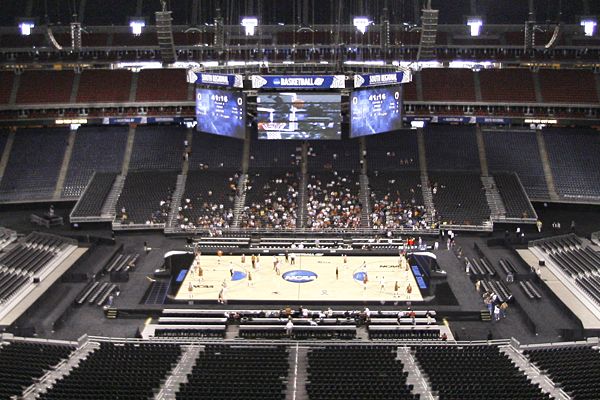
It always seemed slightly awkward that the Final Four, college basketball’s marquee postseason event, is played out in 70,000-seat football arenas across the country, rather than buildings actually designed to house basketball events. Fans spend the season watching their teams compete in basketball arenas across the country, many of which offer unique, quaint environments that are as much a part of the program as the team itself. In world where ticket revenue maximization and logistical considerations are the driving forces behind stadium construction and renovation, it’s these college hoops atmospheres – Hinkle Fieldhouse, Cameron Indoor Stadium, the Palestra – that give the sport a certain level of authenticity. There’s something endearing about the program-specific uniqueness that envelops college arenas, something vaguely intangible the sport simply wouldn’t be the same without. It would only make sense to have college basketball’s national champion determined under the same setting – not only for familiarity reasons, but to preserve college basketball’s amateur feel at the highest levels of competition. At the very least, basketball arenas – if not college structures, then NBA stadiums – offer settings far more tolerable than the large and unseemly football dome monoliths that have been adopted for college basketball’s three most important games (two national semifinals, and the championship game).

Large Domes like Ford Field have exclusively hosted the Final Four since 1997. That’s likely to continue for the foreseeable future (Photo credit: David J. Phillip/AP Photo).

But its no secret why the NCAA has opted for these awkward hosting sites. For one, bigger stadiums means more seats, which means more ticket revenues. If fans are willing to fill a reasonable proportion of a football dome’s enormous seating capacity in spite of several unattractive features – poor viewing angles, increased ticket prices – then it’s hard to argue with keeping the games in these large structures. From a revenue perspective, it just makes sense. But there are a host of other concerns to consider: space for increasing media contingents, infrastructural necessities (restaurants, hotels, parking, etc.), the conventions and parties and fan events that accompany major sporting events like the Final Four. Large football domes, despite all their aesthetic shortcomings, are better-equipped to handle the event in this regard. In short, football arenas in large cities offer the optimal blend of seating accommodations and resourceful necessities for hosting a sporting spectacle as massive and as important as the Final Four.

Read the rest of this entry »

Share this story

Morning Five: 09.11.12 Edition

Posted by rtmsf on September 11th, 2012

  1. In the span of four days, Lance Thomas has become a much bigger name some two years after his graduation from Duke than the role player ever was during his time attending Duke. Everyone who follows college basketball in any capacity whatsoever has an opinion on how and why Thomas got himself embroiled in a jewelry purchase and loan during December 2009 that could ultimately cause the Blue Devils’ 2010 national championship to come under duress if he was in fact ineligible at the time. Here’s a smattering of written opinion on the matter from Monday: ESPN.com‘s Dana O’Neil does a good job framing the debate, but the jewel (ahem) in her piece openly refers to the dilemma that the NCAA faces in pursuing information and potential sanctions against one of its sacred cows. Bylaw Blog‘s John Infante describes the leverage that the NCAA could have over Thomas in order to force him to talk to them (namely, that the jeweler is likely to give his side of the story, forcing Thomas to respond). Over at CBSSports.com, Matt Norlander examines the Thomas case through the prism of troubles surrounding each of the four major programs on Tobacco Road, but the most compelling point in his story is that Thomas at Duke was apparently known as someone not at all prone to flash. Yet… we know that he purchased nearly $100,000 worth of jewelry. So many questions…
  2. Meanwhile, the hits keep coming at UNC. A report from the Raleigh News & Observer on Monday evening disclosed that former Tar Heel quarterback Matt Kupec, who had returned to the school to become its chief fundraiser, tendered his resignation when presented with evidence that he and Tami Hansbrough (the 2008 NPOY Tyler’s divorced mother, also a UNC fundraiser) took personal trips together on the university’s dime. Hansbrough was placed on administrative leave from her job at the school, but given her already tenuous job history at the school and allegations from school chancellor Holden Thorp that some of these trips were to watch her other son, Ben Hansbrough, play at Notre Dame, we’re wondering just how many other surprises there are hiding out on the various servers and job descriptions tangentially related to football and basketball at this university? More to come, we’re sure — welcome to 2012, the year that integrity in college athletics came home to roost.
  3. The Billy Gillispie saga continues to churn along, with additional news on Monday reported by ESPN.com that the Red Raiders’ leading returning scorer, Jordan Tolbert, hasn’t heard from the head coach in two or three weeks and doesn’t want to play for him again. In addition to that, CBSSports.com reported on Monday that Gillispie was not actually on sick leave as many outlets had reported; he is instead using accrued sick time to recuperate and has allegedly told athletic director Kirby Holcutt that he is not well enough to meet. While this very space has all but declared Gillispie’s head coaching career in Lubbock to be over, our Big 12 microsite’s Danny Spewak makes a compelling argument that the media’s general rush to judgment without hearing his side of the story is journalism at its worst — and you know what, he’s right.
  4. Connecticut may not have a lot to play for next season, and depending on the mood of its head coach, they may be looking at a complete programmatic overhaul, but the returning backcourt of Shabazz Napier and Ryan Boatright will ultimately determine the Huskies’ ceiling. The Napier half of that equation underwent surgery late last week to repair a nagging stress fracture on his right foot that doctors felt was not healing quickly enough for the point guard to be ready for the season. The rising junior is UConn’s most talented returning player and a legitimate candidate for Big East postseason individual honors, so they absolutely will need his production next winter to avert a massive cliff dive in both record and status.
  5. Larry Brown is well into his first year as the head coach of the SMU Mustangs, but the sad truth is that the rebuilding process will take some time in light of the paucity of talent left at the Dallas school. With that in mind, perhaps Brown’s open tryout scheduled for September 18 at the Crum Basketball Center will yield a diamond or two in the rough. You never know when a future Hall of Famer like Chicago Bulls great (and Central Arkansas walk-on) might literally stroll through your door. For those of you looking to get some instruction by the only dual NBA/NCAA coaching champion, the deadline to enroll in classes at SMU has unfortunately already passed. Maybe next year.
Share this story

SEC Transition Basketball: Florida Gators

Posted by Brian Joyce on September 10th, 2012

Let’s finish these off this week with the last few of what we’re calling it Transition Basketball, an offseason look at each of the 14 SEC basketball programs. Today’s update: Florida.

State of the Program

Billy Donovan has elevated the Florida program to the status of perennial contender and national powerhouse. Once again last season, his stockpile of talent and aggressive non-conference scheduling paid off. Despite early season losses to Ohio State and Syracuse, the Gators’ high-powered offense tested themselves on the road in some of the most hostile environments but demonstrated improvement throughout the experience. In the end, it was worth it. Though struggling on the defensive end of the court for most of the year, the Gators marched all the way to the Elite Eight, only a couple of made baskets away from another Final Four. But this should almost be expected by now, as Donovan took Florida to the Elite Eight just one year before and won championships in the back-to-back years of 2006 and 2007.

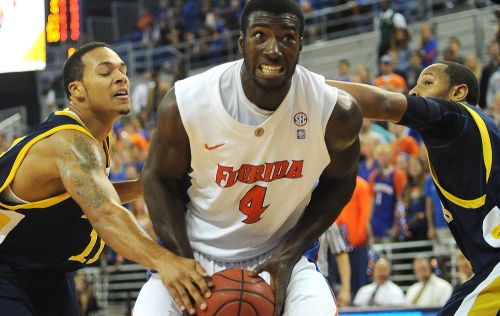
Patric Young will be a beast down low for opposing SEC frontlines this season (Getty)

The scary part is that Donovan has the firepower to make a similar run again this season. Improvement is evident in returning players Kenny Boynton, who is back with his 15.9 points per game at guard, and forward/center Patric Young who brings his 10.2 points and 6.4 rebounds per game back to the low post. Boynton improved his overall field goal percentage from 38.5 percent in 2010-11 to 44.0 percent last year, and his shooting from beyond the arc by seven percent last season. Smooth shooting wing Erik Murphy averaged over 10 points per game last season on 42.1 percent shooting from outside, providing additional stability on the offensive end for the Gators. Will Yeguete returns from injury to improve on his 6.3 rebounds per game. Mike Rosario could make the leap this year from role player to a more significant part of the Florida offense. The transfer from Rutgers averaged over 16 points per game in each of his first two seasons for the Scarlet Knights, but dipped to just 6.6 points per game in his first year with the Gators. He could be called upon to do more in his senior year. It might also be a case of addition by subtraction for Florida as senior guard Erving Walker had never seen a shot he wasn’t willing to take. His 39.4 percent field goal shooting and 2.1 turnovers per game hurt the Gators just as often as he helped.

Read the rest of this entry »

Share this story

A Sexual Abuse Case Against the Most Stunning of Suspects

Posted by dnspewak on September 10th, 2012

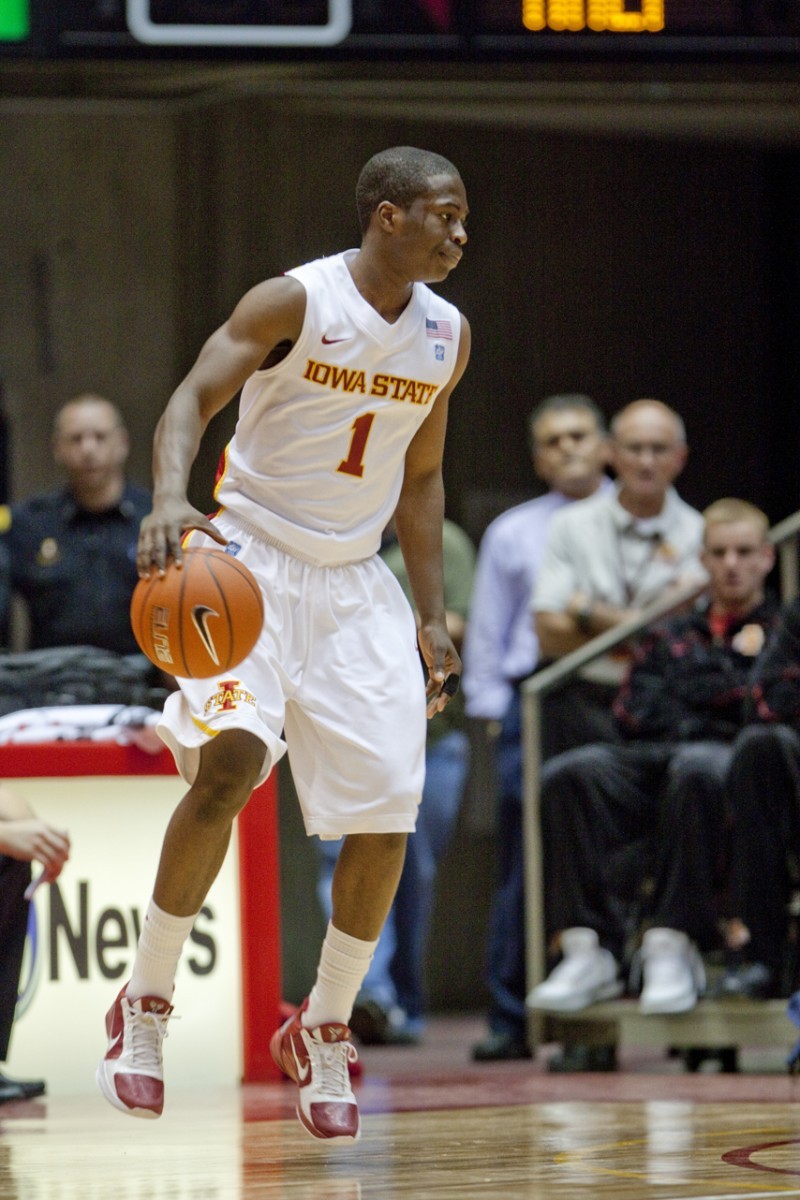
Much like the recent Billy Gillispie and Dez Wells’ stories, it’s important to stay grounded in light of a recent sexual abuse accusation against Iowa State guard Bubu Palo. Head coach Fred Hoiberg has indefinitely suspended his backup point guard, so it’s now time for the legal process to begin. According to police reports, a woman told authorities Palo and another man, 21-year-old Spencer Cruise, drove her to a home in Ames in May and forced her to have sex with them. A sergeant in the Ames Police Department said it collected DNA evidence from both Palo and Cruise, which led to their arrests last week. In fact, Palo turned himself in at the advice of his attorney, and he now faces a serious prison sentence if convicted. Those are the facts of the case, so judge the situation however you’d like. We’re staying out of this debate. It’d be unfair to the victim to assume she’s lying, and it’d be unfair to Palo to assume the accusations against him are true. So instead of taking aside, this is all we’ll say: There are serious allegations against Bubu Palo, and he’ll likely never play for the Cyclones again unless he’s fully exonerated.

The Charges Against Bubu Palo Offer a Cautionary Tale

That’s the story here– that this happened to Bubu Palo. Whether he’s guilty of sexual abuse or not, it would be almost impossible to find a more bizarre candidate to appear in a story of this magnitude. If there were an illustration of the American Dream walking among us in college basketball, it’d be Palo.  Just look at his background. He’s a hometown kid and a graduate of Ames High School. No criminal history. Academic All-Big 12. A former walk-on who earned a scholarship and made a name for himself as a gritty, underrated reserve. So glancing at a headline about sexual abuse and seeing Palo’s name is, well, stunning, for lack of a better adverb.

The accusations also leave Iowa State without a reliable backup point guard, placing a little more pressure on Michigan State transfer Korie Lucious, the obvious starter at that position. Palo was also the longest-tenured Cyclone guard, having played three seasons in Ames, including a redshirt year. Seniors Chris Babb and Tyrus McGee, on the other hand, joined the program last year as transfers. It seems a little silly to talk basketball after allegations of such consequence, however. Iowa State will trudge on for now without Palo, and Hoiberg must now wait patiently until he learns the legal fate of his backup point guard.

Share this story

Right on Cue, Gillispie’s Defenders Tell The Other Side of the Story

Posted by dnspewak on September 10th, 2012

Danny Spewak is a Big 12 microsite staffer and an RTC correspondent. You can follow him on Twitter @dspewak.

Three days ago, the loss of Billy Gillispie‘s employment at Texas Tech seemed like a formality. On the heels of a series of articles from a local Lubbock newspaper, ESPN.com and CBS Sports — in which former and current players said he violated NCAA practice regulations and forced a player with a stress fracture to run stairs — it seemed he’d probably never coach college basketball again, especially in light of his “second chance” following the whole Kentucky fiasco. On Friday, I defended Gillispie’s right to tell his side of the story, arguing media reports had smeared him as he sat in a hospital without any way of responding to the accusations. No reporter had even attempted to write a balanced story, and Gary Parrish of CBS called for the school to fire Gillispie because “there’s no reason to believe” the allegations against him aren’t true. Since then, Deadspin has already reported the school will dismiss Gillispie, though no other outlet has confirmed that claim at this time. It’s bad, folks. Real bad.

So thank goodness for Jason King.

ESPN.com’s senior writer used his connections over the weekend to write a brilliant piece on the Gillispie situation, offering an entirely different side of the tale from the coach’s supporters. On Friday, I asked somebody to call Robert Lewandowski. Apparently, King already had: By Saturday, he appeared in King’s lead, and he stood behind Gillispie by describing him as a tough-love leader, not a madman. Former Texas A&M star Acie Law and forward Joseph Jones said the same thing about their former coach, as did Josh Harrellson (Kentucky) and Deron Williams, who signed at Illinois during Gillispie’s time as an assistant in Champaign. King also garnered a response from Bill Self, a former coaching partner of Gillispie’s, along with Texas Tech color commentator Andy Ellis, who serves as perhaps King’s strongest and most outspoken source. “Somebody needs to tell the other side of the story,” Ellis said.
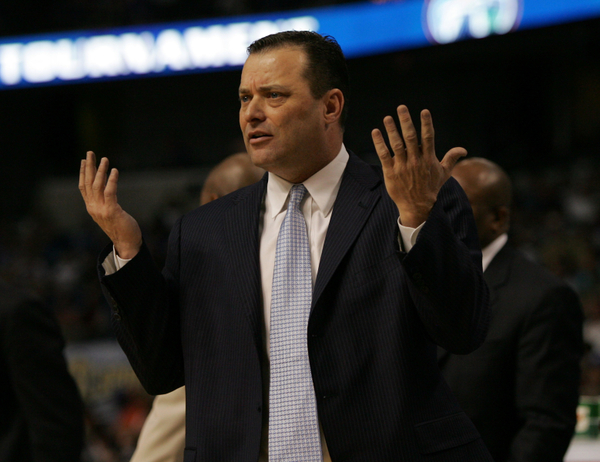
The Coverage of Billy Gillispie Has Been One-Sided to Date

That’s all we’re asking for, and Jason King does a heck of a job doing just that. To be clear, he does not exactly exonerate Billy Gillispie. Ellis points out that former players would of course have a vendetta against Gillispie after transferring, but current players still met with the athletic director about their coach’s conduct and the situation is far from resolved. Lewandowski partly disputed the troubling tale of Kader Tapsboa crying as he ran stairs with a stress fracture, but he offered a fairly vague statement in an effort not to undermine his teammates. Gillispie still may have violated NCAA rules, but after King’s story, at least he’ll get a fair shake. The piece even led to a follow-up from the Lubbock Avalanche-Journal, shedding even more doubt on the matter.

Read the rest of this entry »

Share this story

Will Lance Thomas’ Jewelery Purchases Endanger Duke’s 2010 National Championship?

Posted by Chris Johnson on September 10th, 2012

Chris Johnson is an RTC columnist. He can be reached @ChrisDJohnsonn.

The following names are listed as “clients” on the website of Rafaello & Co. Jewelers: Drake, Jay-Z, T-Pain, Lil Wayne, Rihanna, Justin Bieber. I’m barely scratching the surface of the illustrious canon of entertainment superstars and hip-hop moguls associated with the famous New York jeweler, but you get the point. This is not your average knock-off thrift shop. You don’t walk into Rafaello & Co. unless you have some serious cash to splash. So it’s not at all surprising that Lance Thomas, a starting forward on Duke’s 2010 National Championship team and a current member of the New Orleans Hornets, needed nearly $100,000 to purchase a black diamond necklace, a diamond-encrusted watch, a pair of diamond-stud earrings, a diamond cross and a black diamond pendant in the shape of Jesus’ head. No, what’s surprising is how Thomas was able to pony up $30,000 just two days after Duke defeated then-No. 15 Gonzaga at Madison Square Garden, in the midst of the Blue Devils’ title-winning season. And how Thomas was extended a nearly $70,000 loan to complete the glamorous spending spree. Even more puzzling is the fact that Thomas was expected to repay the loan within 15 days, and that Rafaello & Co. waited over two years to file a suit against him demanding he break even on the very credit he sought when he made purchase.

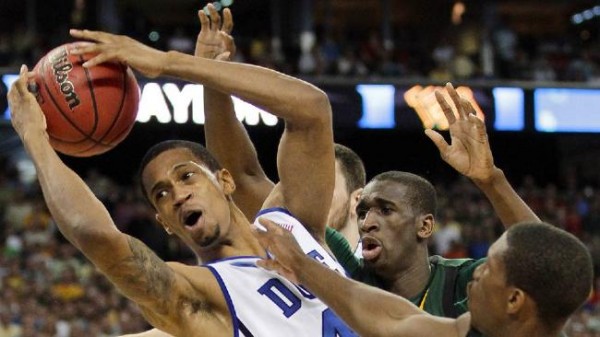
The NCAA will likely investigate Thomas’ involvement in a potential improper benefits scandal, endangering Duke’s 2010 National Championship (Photo credit: AP Photo).

There’s plenty to be resolved here, and it’s far too early to draw conclusions. But unless Thomas somehow managed to accumulate $30,000 (and was expected to raise nearly $70,000 on top of that within the next 15 days) while undergoing one of the more rigorous academic curricula in the nation and, mind you, the added time spent practicing, lifting, studying film and playing basketball at Duke, this situation has the looks of a hanging curve ball, slowly arching its way into the heart of the strike zone, awaiting its bludgeoning from the NCAA’s sanction-laced Louisville Slugger. If college athletics’ ruling body is determined to achieve one mission with its quirky and vaguely byzantine rulebook, it is to sustain the notion of amateurism. Student-athletes are not to use their extra-curricular activities as leverage to obtain financial benefits or other gifts unavailable to non-athletes. Which means Thomas must have received no outside assistance in making a five-figure lump-sum payment at a world-renowned jeweler. He had to have made the money himself. Nor could he have used his status as “Duke forward” to persuade the jeweler into giving him the loan. That’s the baseline assumption we’re making for his innocence. However, if an outside source provided aid when Thomas completed his transaction nearly three years ago, things could get ugly for one of college basketball’s marquee programs and the patron saint that bosses its sidelines.

Read the rest of this entry »

Share this story

Morning Five: 09.10.12 Edition

Posted by rtmsf on September 10th, 2012

  1. The biggest news from the weekend was without question the bombshell that dropped Friday that former Duke forward Lance Thomas is being sued by a New York City jeweler who caters to professional athletes for an unpaid debt of $67,800 — credit that was extended to Thomas upon a down payment of $30,000 and purchase of several items during December of his senior season. This is the same senior season that led to Duke and Mike Krzyzewski’s fourth national championship won over upstart Butler; the same senior season where Thomas started in most of the Blue Devils’ games and contributed five points and five rebounds in roughly 25 minutes per game. Right now, there are more questions than answers — where did Thomas get such a large sum of money to make the down payment? Why would a jeweler give a college student of marginal skill such exorbitant credit? What happened to the jewelry, and did anyone at Duke see him wearing it? Right now, all we know is that the NCAA and Duke both say that they are aware of the issue, but you’d better believe that a nation full of fans of schools other than Duke will be watching this one very, very closely.
  2. Of the six power conferences, the Big East has without question been the one most expendable because of its relative lack of marquee football programs. In an effort to keep up with the Joneses, it has expanded its gridiron presence to include schools from all four US time zones which hasled to understandable mockery over the word “East” in its moniker. Last week former interim commissioner Joe Bailey stated at a sports business conference that the league was investigating a name change to better fit its new national geographic presence. Within minutes of this news releasing, Twitter had a field day making fun of it, no doubt sending current Big East commissioner Mike Aresco into panic mode. Putting the matter to rest on Saturday, Aresco said that there are no plans to change the name, citing “tremendous brand equity” in the conference’s geographic misnomer. Let’s hope for Aresco’s sake that the equity he refers to is more Apple than Enron.
  3. The third buzzworthy item from the weekend related to a comment made by NCAA executive VP for championships, Mark Lewis, late last week. In a conversation with ESPN.com, Lewis said he pulled out a US map and openly wondered why the population-heavy east and west coasts were effectively shut out of the possibility of hosting a Final Four because there are no domed stadiums located in those areas (every Final Four from 1997 to present has been in a dome). The eight existing viable locations — Atlanta, Dallas-Ft. Worth, Detroit, Houston, Indianapolis, Minneapolis, New Orleans, and St. Louis — are generally found in the nation’s mid-section, far from the media hype machines located along the seaboards. The primary impact, of course, would be on the ticket market. Domes are set up to hold upward of 70,000 fans, whereas traditional basketball arenas top out in the low 20,000+ range. We’ve been to a number of Final Fours over the years, and in general have to agree with Mike DeCourcy who argues that the buzz and energy of the building filled with that many people surpasses the tradeoff of a more intimate environment. As a compromise position, we’d offer this suggestion — limit the regional rounds to traditional arenas only, allowing the NBA cities located up and down both coasts regular hosting opportunities; but keep the Final Fours in the dome environments, allowing huge fanbases as well as the general public a reasonable chance to experience one of the great spectacles in all of sports.
  4. As we inch closer to the 2012-13 season, UNLV basketball continues to receive positive attention. The Runnin’ Rebels are loaded with talent and expectations are sky high in the desert. With good attention and expectations comes demands, and the Nevada Board of Regents made an effort to keep head coach Dave Rice happy by approving a raise to a base salary of $600,000 and an extension through the 2016-17 season. Rice’s first season featured the emergence of star forward Mike Moser and a 26-9 overall record although it ended prematurely in the Rebs’ first game of the NCAA Tournament. Next year’s team will add star recruit Anthony Bennett and transfer Khem Birch to bolster the front line along with Moser, making UNLV a chic preseason pick to make a run at the 2013 Final Four.
  5. The 2012 Basketball Hall of Fame class was inducted on Friday night, and as always, college basketball was well-represented. The biggest name from our game was Virginia’s three-time NPOY Ralph Sampson — for those of you under 40, read that part in italics again — a player who was so utterly dominant during one of the most talented eras the sport has ever seen that his NBA career (only four All-Star appearances) pales in comparison. Other college stars of note were UCLA’s Jamaal Wilkes (two-time first-team All-American), UCLA’s Don Barksdale (second-team All-American), Reggie Miller (two-time first-team Pac-10), Iowa’s Don Nelson (two-time All-American, although he was selected for his coaching), Bradley’s Chet Walker (two-time All-American), New Mexico’s Mel Daniels (second-team All-American) and referee Hank Nichols. An interesting non-basketball-playing inductee was Nike CEO Phil Knight, whose impact on the sport through his sneakers and corollary marketing efforts have been incalculable.
Share this story

SEC Transition Basketball: LSU Tigers

Posted by Brian Joyce on September 8th, 2012

Wrapping up the SEC transition basketball series with today’s update: LSU.

State of the Program

Other than a home win over Marquette in December, last season was not much to brag about for the LSU Tigers. A 10-3 start to the season had Tigers fans optimistic heading into conference play, but that feeling quickly dissipated after LSU lost six of eight games through one stretch. An 18-15 season was not enough to spark excitement for a fan base looking for any reason to hold onto hope. Coach Trent Johnson announced his departure from Baton Rouge in March. And lo and behold, a spark ignited.

Johnny Jones takes over in Baton Rouge. (Chris Graythen/Getty Images)

Enter North Texas coach and former LSU Tiger, Johnny Jones. Jones, who was part of two LSU Final Four teams as a player and an assistant coach, was chosen to lead the Tigers out of its path of recent mediocrity. UNT won two Sun Belt championships under Jones, and LSU is hoping for similar success in the SEC. The Tigers haven’t been to the NCAA Tournament since the 2009 season when they won the SEC with a 13-3 conference record. For Jones to keep the flame lit, an NCAA Tournament berth has to come sooner rather than later.

Read the rest of this entry »

Share this story

John Calipari Gives “You” A Tour Of Kentucky’s Basketball Dorms

Posted by nvr1983 on September 8th, 2012

Yesterday, John Calipari posted a video on his personal site giving the first public tour of Kentucky‘s Wildcat Coal Lodge, a new dormitory for the men’s basketball team and “other UK students”. Outside of it being a very nice dormitory (let’s just say it is several steps above what either of RTC’s editors lived in as freshmen) it is pretty clear that this just a recruiting tool that is aimed at the top recruits in the nation (or world).

After watching it we only have two questions:

  1. How does this compare to the basketball/football dorms for other top programs?
  2. Who are these “other UK students”?

While there were some issues with athletic dorms in the past–to the point that the NCAA ruled in 1991 that they had to be phased out by 1996–we have seen photos of several well-appointed facilities. If Kentucky can put together the money for this for their basketball team we are sure that at places like LSU and Alabama they put their football players in more than your typical freshman dorm.

This is more like what our freshman dorm looked like (Credit: Dormdelicious.com)

There are probably more than a few of you who are like a couple of the people leaving comments on Calipari’s site who are questioning the appropriateness of spending that much money on housing for basketball players given the state of the economy including at Kentucky where 140 employees were recently laid off and tuition is being raised to help correct a $43 million budget deficit. We won’t get into the argument over whether athletes should get special treatment in comparison to the revenue they get, but this $8 million dorm was funded through money given by private donors. Still we are certain that displays like this will only serve to enrage certain individuals.

Share this story