






Winners & Losers From Conference Realignment (so far)

Posted by rtmsf on June 18th, 2010

Andrew Murawa is the RTC correspondent for the Pac-10 and Mountain West conferences and an occasional contributor.

With the news on Thursday that Utah has received and accepted the invitation to become the 12th member of the Pac-10, it looks like the college sports realignment apocalypse has been averted for the summer. There may be further movement on down the line, but all signs point to a relative period of calm after weeks of frantic scrambling from all corners of the country. While it was a pale substitute for actual on-court play, we did have plenty of intrigue and suspense, action and strategy, and winners and losers. Now it’s just a matter of sorting out who was what.

The Greatest and Still Champion

Texas

A Lot to Be Happy about in Austin These Days

Texas definitely fits in the “winner” category, but I think lumping them in with these other schmucks below would be selling them short. And I’m sure they would agree. The Longhorns played this about as well as could be played, and they got everything they wanted out of it. The Big 12 keeps their television deal with ESPN (which doesn’t expire until 2016), but only has to share the proceeds among ten schools rather than twelve. The conference received a promise from Fox for a new deal when their current deal expires, with exponential increases in revenue on tap. And, on top of all that, Texas retains the right to sell local television rights and is free to explore its plans for a Longhorn television network. Bonus: in the process of trying to keep the Longhorns in the Big 12, there are reports that the neediest institutions in the bunch agreed to a plan that sent all of the money that Colorado and Nebraska owe the conference in buyout fees (reported to be somewhere between $10 and $40 million, depending on the source) to Texas, Texas A&M and Oklahoma. So, in the span of a week, without losing any of their traditional rivals in the Big 12 South, Texas goes from generating somewhere in the $12 million range in television revenues to earning an estimated $20-25 million annually. And, that’s not even the best of it. In the process, it became painfully obvious that Texas is the big dog in the conference and the other schools (aside from Texas A&M) are in some manner, just riding coattails. Schools like Oklahoma and Texas Tech made it clear that they were just going to do whatever Texas did, while others, like Missouri, Kansas, Iowa State and Baylor, had their futures twisting in the wind, reliant on Texas to save them. If the Longhorns had gone to the Pac-16, they would have just been one of the sixteen there. By staying at home, they are clearly the kings of their conference.

The Winners

Texas A&M

The Aggies showed themselves as the one school in the conference that had plans of their own regardless of Texas. While Oklahoma and others were happy to just do whatever Texas decided, A&M talked to the SEC, and by all reports, actually had an offer to join that conference. But, in the end when they could have run off and forced Texas’ move west, the Aggies agreed to stick around and share in the league’s windfall, excellent news for an athletic department that was $16 million in debt, and even better for a school whose once proud football program has fallen on hard times in the past decade.

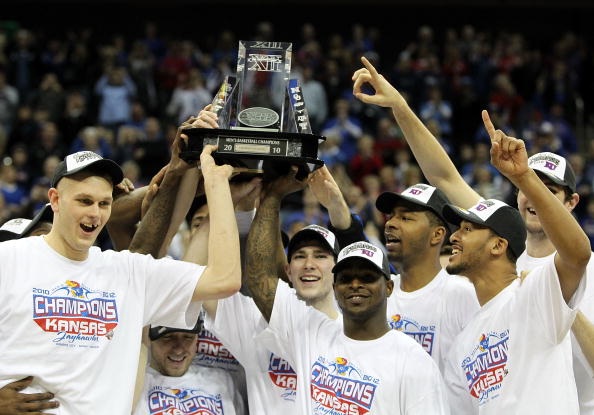
Big 12 Basketball

Without a doubt, the Big 12 became a better basketball conference overnight. Over the last nine years, both Colorado and Nebraska have had an average finish of around ninth in the conference. Nebraska has never won an NCAA tournament game. Colorado has only had two NCAA tournament berths in the last 40 years. So as far as the basketball side of the equation goes, this is addition by subtraction at its finest. As the conference makes the transition to an 18-game schedule in which each team will play a full home-and-home round-robin, they will no longer have to worry about games against the Buffs or Huskers dragging down their RPI. Every night in the conference will be tough sledding, but every team in the conference will also have a better chance to build their resume for postseason play.
Watch Out, Big East and ACC...

Chip Brown and Orangebloods.com

Chip Brown has been the point-man on conference realignment for about two weeks now. He broke the original story about Texas dragging five other Big 12 schools to the Pac-10, and when Texas blinked in the 11th hour, it was Brown who had that story first as well, even in the face of ESPN reporting the opposite. In the process, Brown, a former writer for the Dallas Morning News, has seen his Twitter followers increase exponentially, and the profile of Orangebloods.com, a Longhorn Rivals site of which he is part owner, has jumped from something that was only known amongst the most attentive Longhorn fans to an important resource for those of us following this story.

Utah

The Utes received just $1.2 million in television revenue from their association with the Mountain West Conference. Presently Pac-10 schools earn somewhere in the $10-$12 million neighborhood from their television contracts, and with the Pac-10 set to negotiate a new television deal which will begin the 2011-12 season, the Utah athletic department stands to make a nice chunk of change for very little trouble.  While the basketball program is going through a rough patch presently, it wouldn’t surprise anyone to see the Utes be right in the thick of things in the Pac-10 football chase immediately.

ABC/ESPN and Fox Sports

Both networks stepped in to help save the Big 12. ABC/ESPN agreed to keep their current contract with the Big 12, allowing the ten remaining members to split the revenues that had previously been divided amongst twelve. Fox Sports also agreed to large increases in their agreement with the Big 12 which expires next offseason. If Texas had bolted for the Pac-10 along with five other Big 12 members, both ESPN and Fox Sports would have had a major bidding war on its hands for the rights to the new Pac-16 conference television deal. The breakup of the Big 12 would likely have meant other moves by the Big Ten or SEC or ACC, moves that could have resulted in their contracts needing to be reworked. In the short term, both entities probably overpay for the Big 12 rights, but they saved themselves plenty of cash in the long term.

Big Ten

While it may have appeared to be the first rat on the way out before the ship went down, Nebraska’s move to the Big Ten makes a lot of sense, at least football-wise. Adding the Huskers gives the Big Ten four iconic football programs, the ability to hold a championship game and a fanbase that will eat up anything Huskers on the Big Ten Network. And, passing on Missouri is probably the right move as well. Picking up one Big 12 team brings the Big Ten to 12 schools, and allows them to take their time with any additional expansion they may be interested in, while getting the benefits of the 12th team. If the Big Ten chooses to pursue further expansion, it will be mostly focused on Big East teams, including the great white whale, Notre Dame.

The Losers

Missouri

Read the rest of this entry »

Share this story

Morning Five: 06.16.10 Edition

Posted by rtmsf on June 16th, 2010

  1. Yesterday’s big realignment news was that if you can believe what Craig Thompson, the Commissioner of the Mountain West, has to say, the Pac-11 has yet to contact Utah about possibly becoming the twelfth member of that league.  Don’t worry, Mr. Thompson.  They will on Wednesday.
  2. As for this new 12-team conference, how will the divisions be configured?  Dividing them up into two six-team divisions by geography (North/South) makes sense, but one idea that has some alternative support is the so-called “zipper” format in football (with rivals separated) and a three-division format in basketball.  Wazzu blog CougCenter explains these two ideas.
  3. So… about the new Big 12/10.  We wrote yesterday that we think the league will become a much stronger basketball conference as a result of the loss of bottom-feeders Nebraska and Colorado, but we’re not the only ones who thinks that handing the keys to the conference almost completely over to Texas will result in storm clouds again a few years down the road.  The Pac-11 was smart to not allow UT to wield such disproportionate influence in its league for fear of upsetting the others members — how will this ultimately play in the rest of the Big 12/10 when the collective back-slapping and good tidings die down?
  4. Remember Brad Stevens?  He says that the newfound fame that his Butler program and he personally enjoyed throughout March and April of this year is finally dying down.  Undoubtedly true, but it’ll pick back up again in December when people realize that Butler is 11-0 and in the top 10 again.
  5. We wondered aloud about Washington’s Abdul Gaddy all of last season.  For a player rated out of high school as the second-best point guard behind John Wall, his season averages of 3.9 PPG and 2.2 APG on 41% shooting (15% from three) are completely ridiculous.  He’s playing in the U-18 men’s national team this week and Percy Allen of the Seattle Times caught up with him.  The problem?  Missing his swagger, apparently (translation: thinking he was better than he actually was).
Share this story

Texas Standoff Ends With Survival of the Big 12, er, 10…

Posted by rtmsf on June 14th, 2010

Andrew Murawa is the RTC correspondent for the Pac-10 and the Mountain West conferences and an occasional contributor.

The Big 12 went all the way to the brink, peered over the other side into non-existence, and then veered away from the white light at the last minute. The patient is now resting comfortably in Austin, although it has lost a little weight.

After last week’s rumors that the University of Texas was all but signed up to head to the Pac-10, bringing Oklahoma, Oklahoma State, Texas Tech, and potentially Texas A&M or Kansas along for the ride, Big 12 commissioner Dan Beebe pulled off perhaps the biggest longshot in the college sports year, reportedly in conjunction with an influential group of concerned citizens both within and outside of the world of college athletics, pulling Texas back from the brink with promises of SEC-type money and an ability for the Longhorns to start their own television network, the revenues of which they’ll be able to keep all for themselves. And, just as a little bonus, the remaining ten Big 12 schools (yes, it appears that for the near future, the Big 12 will have ten schools and the Big Ten twelve) will get to split the nearly $20 million in buyout penalties that Colorado and Nebraska must pay for leaving the conference. Maybe Christian Laettner’s shot and Doug Flutie’s pass were more exciting to watch, but Beebe’s last chance attempt at holding the Big 12 together will have a much larger long-term impact on the college sports landscape.

The Most Powerful Athletic Program in College Sports

Texas

The biggest winner here is Texas, on several fronts. According to Beebe’s projections, the Big 12’s next television deal coupled with projected income from a Longhorn television network could provide the university with between $20-$25 million annually, a marked increase from the estimated $10-$11 million they are currently generating.  And, the Longhorns get to remain in a conference with its historic rivals, many of whom were either in the position a few days ago of  doing whatever Texas decided it was going to do, or being left behind if Texas did leave. While the Big 12 was already painted as Texas and the 11 dwarfs before the last week, that image has been cemented in everyone’s minds now. Clearly that will be just another useful recruiting tool for Texas athletics.

Texas A&M

The Aggies come across as the only school in the Big 12 whose leaders were able to think of themselves in a way other than their relationship to Texas. If Texas had made the decision to head west, A&M was already well on its way to paving its own road to the SEC. Whereas before this mess, most would have pointed at Oklahoma or maybe Nebraska as the strong number two program to the Longhorn Ace, Texas A&M went a long way this week toward establishing their own identity. And then, of course, at the last minute the Aggies blinked. Fortunately for them, big daddy Texas still had their backs.

The Little Twelve

So what happens to the conference as a whole? It gets significantly richer, while being in the excellent position of dividing up a bigger pie up into fewer pieces. Beebe’s number should certainly be retired, and any time that he shows up at a Big 12 sporting event for the rest of his lifetime, they should roll out the red carpet for him, sit him down at a nice courtside throne and pay off a few cheerleaders to fan him with feathers and feed him grapes. Iowa State in particular was certainly on the verge of relegation to a mid-major program with Baylor likely not far behind. Missouri’s administrators, who not long ago talked of their involvement in the Big 12 in the past tense, have been saved as well from peddling their wares on the street corner. Kansas and its pre-eminent basketball program has been spared the indignity of either playing out of region in the Big East or asking for shelter from the Mountain West. And all these longtime rivals (or at least most of them) get to continue beating each other up on the playing field. Without a doubt, the 2010-11 season has just taken on some added significance.

Beyond all that, there are the details. First, is this league still the Big 12? We’ve put up with the Big Eleven still calling themselves the Big Ten if only because they were sorta old and quaint, perhaps a little senile, and who could blame them if they couldn’t count anymore. Sure the Atlantic 10 has 14 members, but the Atlantic 14 sounds like a really bad sequel to Ocean’s Eleven. But we really can’t have the Big 12 operating with ten members (assuming they actually stay at ten – more on that in a second), still calling itself the Big 12, can we? The easy solution is to just have the Big Ten and Big 12 swap logos, but something tells me we’re stuck with these names.

Read the rest of this entry »

Share this story

Thanks, But No Thanks — Texas Sticks

Posted by jstevrtc on June 14th, 2010

More on this later this evening from our man out west, but ESPN and several other outlets are now reporting that Texas (and evidently Texas A&M, as well) has officially turned down the Pac-10 and will stay in the Big 12, a conference whose headquarters just outside of Dallas had vultures circling over it as recently as yesterday.

Now that Texas is staying, it seems like conference realignment has been a lot of flirting and -- as far as college hoops fans are concerned -- minimal action of any importance.

If the current reports are true, with Nebraska headed to the Big Ten, Colorado moving to the Pac-10, and Boise State bolting to the Mountain West, the biggest college basketball-relevant change of conference might be — who would have guessed? — Utah, expected to join the Pac-10 at any moment.  Indeed, across all sports, it might just be the case that all of this conference realignment talk and the predicted death of leagues might end up just being like a bachelorette party that got a little out of hand:  some quick decisions that led to a couple of broken relationships, and some very serious flirting by the others that almost led somewhere dangerous.  But, in the end, everyone wound up back home where they belong.

Share this story

Morning Five: 06.14.10 Edition

Posted by rtmsf on June 14th, 2010

  1. Tom Izzo update — shockingly, the Michigan State coach is still considering the Cleveland Cavaliers job, but a report that surfaced late Sunday night stated that LeBron James would be behind the Izzo hiring.  What’s less clear is whether that means James would support the hire as a member of the Cavs or as a member of some other team, a key distinction surely not lost on Izzo in trying to make his decision.  Honestly, the only way that this move makes sense for Izzo is if he can rest assured that he’ll have the opportunity to coach LeBron; otherwise, he’ll be in much the same position that his collegiate forebears such as Pitino, Calipari and Floyd found at the next level — in possession of a swollen bank account but an emaciated roster.
  2. You typically don’t see this happen often, but Ralph Willard did it last year when he left Holy Cross to become an assistant at Louisville and now Indiana State head coach Kevin McKenna is leaving his post to become an assistant under Dana Altman at Oregon.  McKenna was only 43-52 in his three seasons at ISU but he did get the Sycamores to the CBI last year, so you wonder what might have been the underlying reason for this move.
  3. Was the Pac-10 taking another look at Kansas in light of rumors that Texas A&M is more interested in moving to the SEC (leaving the rest of the Big 12 South to the west coast)?  Pac-10 Commish Larry Scott was scheduled to stop over in Kansas City on Sunday night, but apparently the plane never showed up.  Does this mean that A&M is back on board with the move west?  And what of Missouri, who was so gung-ho about joining the Big Ten a month ago, but who is now scrambling around to try to save itself and the rest of the Big 12 (good luck with that).  Sensing an opportunity to improve its profile, the Mountain West is already looking at both schools as possible expansion candidates.
  4. D-day for the Big 12 will be Tuesday, as the regents for the University of Texas will meet to decide what, if anything, to do about the reported offers to join the Pac-10 or the SEC versus staying put.  If the Horns decide to move, the Big 12 will probably be kaput as a major conference, a doomsday situation that had its commissioner spending the weekend trying to convince UT brass that a 10-team conference could still remain viable and that the school would be free to pursue its own television deal (presumably something the new Pac-16 would not allow).  Stay tuned — much more will undoubtedly happen this week.
  5. FedEx CEO Fred Smith has his own ideas about conference realignment — if any BCS league agrees to take his beloved Memphis Tigers into its fold, that league could earn up to $10M yearly for the invitation.  The most likely beneficiary?  The Big East, especially if the Big Ten as expected raids some of the conference’s football-playing schools.
Share this story

Mr. Toad’s Wild Ride — Just Beginning…

Posted by rtmsf on June 12th, 2010

Andrew Murawa is the RTC correspondent for the Pac-10 and Mountain West conferences and an occasional contributor.

When we first started looking at all the possible ramifications of Big Ten expansion and the ensuing conference realignment, we knew this was going to be crazy. This week, as the first dominoes have officially fallen, we’re getting a better feel for just how crazy it is, as new rumors fly by the hour and every move that gets made signals another set of decisions that need to be discussed and everybody’s got an opinion about what could happen, what should happen, and what will happen.

Today, another couple dominoes fell, as Nebraska officially announced its agreement to join the Big Ten and Boise State officially announced its intention to join the Mountain West. Not only do both announcements end days, weeks, even months of speculation and at the same time trigger a whole new round of speculation, each comes with something of a surprised attached.

First, Nebraska, the biggest domino (at least until Tuesday). While the announcement was expected today after a wild week, there were plenty of surprises tied in with the announcement, the biggest and boldest being that rather than begin play in the Big Ten in 2012, they hope to kickoff the 2011 season playing in the Big Ten, meaning next year may well be the last year of existence of the Big 12, and likely a wild and emotional one at that. Other surprises include the fact that according to what was said today, it was Nebraska that first approached the Big Ten about membership, rather than the other way around, and the comment by Big 12 commissioner Dan Beebe that Big Ten commissioner Jim Delany said that they weren’t likely to be interested in any further Big 12 schools. While that last little bit of BCS-conference commissioner gossip may be little more than game-of-telephone talk, it cannot do anything to comfort Missouri, who more and more looks like they will be left out of the Big Ten when the wheeling and dealing is done.

Nebraska’s move will likely trigger the full-fledged collapse of the Big 12, as Texas drags most of the rest of the Big 12 west to the new Pac-16 superconference, something we saw as a possibility six weeks back, but perhaps never really believed. There are still questions as to who else beyond Texas will make it to the Pac-16, as Texas A&M is in serious talks with the SEC regarding a new home for the Aggies there, possibly with Virginia Tech, although other schools ranging from other Big 12 schools to ACC football powers could still be in the mix there. Oklahoma has also been tied to SEC rumors, but their athletic director Joe Castiglione said yesterday that they would be following Texas’ lead and the Oklahoman reported today that OU and OSU are definitely heading west, although they will wait until Texas makes their decision official to follow suit. As of right now, it looks like Texas will announce on Tuesday their intention to join the Pac-10, and sometime after that, Oklahoma, Oklahoma State and Texas Tech will follow, with the 16th spot going to Texas A&M if they are willing to take the leap. If not, Kansas and Utah seem to be the most likely candidates. Also note that with the Nebraska announcement that they will begin play in the Big Ten in 2011, it is possible that the Pac-16 will also be in effect that same year, one year earlier than expected.

Speaking of Utah, they are, for the time being, conference mates with Boise State in the Mountain West, a move that makes an already strong conference even stronger, at least football-wise. (As an aside, we’ve talked about how this conference realignment action really shows that basketball is the red-headed step-child to football, and just to drive that point home, the first three dominoes in the chain reaction, Colorado, Nebraska and Boise State, are all complete non-factors in college basketball). The Boise State announcement was originally expected on Monday, but after last weekend’s eruption of rumors regarding the Pac-16, et al, both the Mountain West Conference and Boise State found it prudent to take a step back and re-assess their position in the case of the Pac-16 becoming a reality and the Big 12 dissolving. Clearly, they found that as the rumor became reality this week, the dissolution of the Big 12 did not hurt the conference, and in fact, may provide the conference the opportunity to grow. Teams like Baylor, Iowa State, Kansas, Kansas State and Missouri may be within reach for the Mountain West, with Kansas being the most attractive target, but also perhaps the least likely get. Baylor would be a very good fit for the conference as a regional partner for TCU, but all of the Big 12 leftovers will at least get a look from MWC commissioner Craig Thompson. Thompson confirmed on Friday that he has already been in contact with some Big 12 institutions and sees this as an opportunity for the MWC to get better.

What’s next?

Read the rest of this entry »

Share this story

Colorado Starts The Chain Reaction

Posted by jstevrtc on June 11th, 2010

Andrew Murawa is the RTC correspondent for the Pac-10 and Mountain West conferences and an occasional contributor.

Following yesterday’s whirlwind of activity surrounding the Big Ten, Pac-10 and Big 12, today was a relatively mild day. All that happened, was, you know, the first actual confirmed move of a school from a conference to another, as Colorado and the Pac-10 announced their agreement to have the Buffaloes begin play in the Pac-10 conference beginning in the 2012 academic calendar. While rumors continue to fly that five additional Big 12 teams will be invited to join the Pac-10 (at least that’s still the name of the conference right now) and that Nebraska and the Big Ten will formally announce their union tomorrow, the Colorado move is still the only move that is signed, sealed, delivered and announced.

Seen here in their heyday, the Bigtwelveosaur and Bigeastosaurus were blown into extinction by the conference realignment asteroid of 2010.

Pac-10 commissioner Larry Scott also mentioned on Thursday that his conference will not necessarily add any more teams after Colorado, a comment that is seen as little more than a smokescreen before further announcements come.

Read the rest of this entry »

Share this story

The First Domino: Nebraska?

Posted by rtmsf on June 10th, 2010

Andrew Murawa is the RTC correspondent for the Pac-10 and Mountain West conferences and an occasional contributor.

On a busy day in the sports world (Steven Strasburg, NBA Finals, USC sanctions, World Cup, Izzo to Cleveland, etc.), the most chatter throughout the land was about Nebraska either with one foot already in the Big Ten – or not, depending on who you ask.

Nebraska the First Domino to Fall?

Once again, Orangebloods.com and their columnist Chip Brown are leading the way on this, and he is reporting that this is close to a done deal. A quick run-down of his reporting:

  1. Nebraska’s Board of Regents has informally agreed to join the Big Ten and that would become official with an announcement on Friday.
  2. There is, in fact, an invitation from the Big Ten for Nebraska.
  3. Sources from Texas, Texas A&M and Texas Tech have intimated that if Nebraska leaves the Big 12, the conference would be beyond help.
  4. Texas president William Powers and athletic director DeLoss Dodds informed Texas coaches today that their attempts to save the Big 12 were unsuccessful.
  5. The Pac-10 will invite the six teams reported first last week — Colorado, Oklahoma, Oklahoma State, Texas, Texas A&M and Texas Tech — and those invitations will likely be accepted, with the new conference alignment going into effect in 2012-13.
  6. Officials from Texas and Texas A&M will meet on Thursday to confirm their plans in the event of the dissolution of the Big 12.
  7. Missouri, which has burned bridges with the rest of the current Big 12 members while attempting to garner an invitation to the Big Ten has been “getting the cold shoulder from the Big Ten” according to a Big Ten athletic director and could be on the outside looking in.
  8. Joe Schad of ESPN reports that the Big Ten remains interested in Notre Dame, and with Nebraska added, its fourteenth member is likely to be either Maryland or Rutgers.
  9. There is in fact a deadline of June 14 for Colorado, Missouri and Nebraska to commit to the Big 12.
  10. Baylor, which had been rumored as a possible Pac-10 invitee in lieu of Colorado, is off the table due to the objections of some Pac-10 administrators towards adding a religious institution.

Elsewhere, ESPN’s Chris Mortensen is reporting that Nebraska athletic director Tom Osborne has informed staff members that a move to the Big Ten is imminent. And Nebraska’s move has been reported as finalized by Teddy Greenstein of the Chicago Tribune. Greenstein also quotes Big Ten commissioner Jim Delany as saying that the Big Ten could “act and act again,” read as that while the Nebraska invite appears to be the only imminent move, there could be additional moves by the Big Ten down the line. And Chris Dufresne of the Los Angeles Times reports that the Pac-10 invitations to the six current Big 12 schools are “locked and loaded.”

Osborne has since denied that there is any final decision made, has denied that he told his staff that the move was coming, no member of the Nebraska Board of Regents has gone on record confirming any of this, officials from both Texas and Nebraska have denied these reports and there has been no word from the Big Ten that an invitation has been extended to Nebraska. But, while there is no official, on-record confirmation of any of this at this point, there is an awful lot of smoke here for there to be no fire. It looks like the first domino has been pushed over, and the remaining dominoes could fall very quickly from here on out.

Nebraska

Starting with Nebraska, this is a huge move for an athletic department that prides itself on tradition. In making this move, they are cutting themselves off from their entire history. It has been more than 80 years since Nebraska has competed in a conference that did not include Iowa State, Kansas, Kansas State, Missouri, and Oklahoma, but if they accept entry into the Big Ten, that link is over. While it still remains possible that Missouri could follow as well, the other four schools are clearly not bound for the Big Ten. From its administrators on down to its die-hard fan base, this move could not have been an easy one to make, certainly one that has been looked at from every angle before a decision was made. But if the decision has been made, Nebraska is just the first big stone in what looks like an avalanche to come.

For the college hoops fan, the Nebraska move is only important in terms of the other moves it triggers. Let’s face it, Nebraska is one of the weaker basketball schools historically of the current BCS conference schools. In their history, they have made the NCAA tournament six times, the last time 12 years ago. They have never won an NCAA Tournament game. Beyond that, they’ve made 16 NIT fields. That’s it, the sum total of Cornhusker success in basketball. But their impact on the way the sport’s landscape will look beginning in 2012 cannot be understated, something the Mayans clearly knew when they made their calendar.

Big Ten

For the Big Ten, this move is likely just the first in a series of moves, and one forced by timing. If the Big 12 had not issued their ultimatum, things could have played out a lot slower and the Big Ten may have been able to announce all their moves at once. But if serious talks were already ongoing between the Big Ten and Nebraska (and there is no reason to believe they weren’t), the ultimatum made Nebraska get assurances from the Big Ten that if they were to leave the rest of the Big 12 hanging, they would indeed get an invite.

The news about Missouri being ignored by the Big Ten is nearly as interesting as the news that Nebraska is going. Just a week ago it was assumed, by me at least, that Missouri and the Big Ten were a foregone conclusion and that Nebraska might be left out in the cold. Now there are reports that the only way Mizzou gets an invite to the Big Ten is if they decide to go all the way to 16, and even then, Missouri may have to fight off teams like Connecticut, Pitt and Syracuse to get the invitation.

Notre Dame still remains the Big Ten’s priority, even more so than Nebraska. However, the Big Ten is reported to have given Notre Dame a deadline to make its decision. Giving Notre Dame a deadline could spook the Irish if they feel like the Big Ten would raid the Big East for teams like Rutgers, Pittsburgh, Syracuse and/or Connecticut, effectively gutting the Big East and killing off the football side of the equation there. It may be up to ND to call the Big Ten’s bluff if they figure (probably rightly) that the Big East basketball-only schools will remain together even if the football league dissolves.

And then there’s Pitt, rumored all along to at least be in the running for a Big Ten invitation. However, Jim Delany commented on Sunday that expanding the Big Ten’s presence in Pennsylvania is not a priority for the conference in expansion, despite the fact that 17 percent of the state does not have access to the Big Ten Network, the largest percentage of any state in the conference’s footprint. While that isn’t the last word on the subject, it looks like Pitt is running behind.

Pac-10 or Pac-16

For the Pac-10, the Nebraska move goes a long way toward turning it into the Pac-16. With Nebraska gone, Missouri looking for anywhere else to go, and Colorado already California dreaming, if Texas is sufficiently spooked about the long-term prospects of the Big 12, they’ll be headed west with the rest of the Big 12 six. Then, presumably, the Pac-16 creates its new cable network and….. profit! Along the way, the only remaining major conference with a full football round robin AND a full home-and-home basketball round robin expands to 16 and has to come up with some sort of plan to create a reasonable schedule in both sports, not an easy task.

Read the rest of this entry »

Share this story

Boise State-us Quo, Baylor, And The Ultimatum: The Expansion Latest

Posted by jstevrtc on June 7th, 2010

Andrew Murawa is the RTC correspondent for the Pac-10 and Mountain West Conferences and an occasional contributor.

On the heels of recent rumors regarding the Pac-10’s plans to invite six Big 12 schools to leave their current home for a new superconference, the Big 12 is looking for assurances that all of its current members are committed to the conference. At the Big 12 meetings in Kansas City this week, nine of the 12 schools gave their commitment to the Big 12, but the three schools with the likeliest chances of invites elsewhere – Colorado, Missouri and Nebraska – declined to do so. As a result, the remaining Big 12 schools have issued an ultimatum to all three schools, mostly focused on Nebraska, to either commit fully to continued membership in the Big 12 or else be ready to watch it dissolve. While there is no reason that any commitment these schools give to the Big 12 would be in any way binding and there is no “or else” necessarily specified, reading between the lines it looks like if the six schools tied to the Pac-10 rumors do not get assurances from Nebraska that they will remain Big 12 members, those six schools will pursue their opportunities with the new Pac-10 superconference.  So, while the Big 12 feels that can withstand the loss of Missouri and that Colorado isn’t going anywhere without other members of the conference, if Nebraska is not ready to commit to the rest of the conference and foreswear possible Big Ten membership, the invited six are ready to join up with the Pac-10.

In a related story, there is also news that the Texas state legislature is at it again, mixing it up in inter-collegiate sports in an attempt to save Baylor from being left behind. Orangebloods.com is reporting that there is a group of Texas lawmakers trying to make a push to force the Big 12 to take Baylor instead of Colorado, by doing something like not allowing Texas to leave the Big 12 for the Pac-10 if Baylor is not invited as well.  Also, it seems that rather than deal with a big legal and political hassle, the Pac-10 would be willing to substitute Baylor for Colorado, despite the desire for the lucrative Denver television market. This, of course, has happened before with Baylor. When the Southwest Conference broke up in the mid 90s, Texas, Texas A&M, Texas Tech and Baylor were offered invitations to join the Big 8 schools, creating the Big 12. It was then-Texas-governor Ann Richards, a Baylor alum, who insisted that Baylor be included in any plan with Texas state universities joining the Big 8 schools. This time around, it may be new Baylor president Ken Starr (yes, THAT Ken Starr) who is leading the charge to keep Baylor tied to the hips of the other Big 12 Texas schools.

Read the rest of this entry »

Share this story

Morning Five: 06.04.10 Edition

Posted by rtmsf on June 4th, 2010

Without question, the condition of John Wooden is the most important concern in the world of college basketball right now, and certainly beyond it, and we will be updating the site as needed on that issue.  Because that is obviously a subject that demands much greater reflection, today’s Morning Five links five other stories relevant to our sport.

  1. This has been a very busy week for college hoops news despite the calendar showing June.  We know that it won’t be today as we had all originally heard, but at some point in the near future USC will learn its NCAA-meted fate as a result of the Reggie Bush/OJ Mayo/Tim Floyd eras.  Should the Trojan faithful be worried?  Mike DeCourcy believes that the hoops program will come out relatively unscathed, but Floyd and the footballers?  Not so sure.
  2. Is the Big 12 seemingly disintegrating right before our very eyes?  It would certainly appear to be the case after yesterday’s report that the Pac-10 is looking to raid the southern half of the conference and a stalwart such as Missouri failing to calm the whispers about its imminent move to the Big Ten.
  3. Great story today by ESPN.com’s Dana O’Neil about Bill Courtney, the new head honcho at Cornell, and his boundless optimism.  He definitely seems like the kind of guy for whom it would not just be fun to play, but maybe play hoops with, as O’Neil references in the article.  It’s tough taking over a program that just had one of its best seasons and just lost its key players, but it sounds like Courtney will enjoy and smile right through any weighty expectations.
  4. We know about DePaul not releasing Walter Pitchford from his LOI, and here we go again.  Joseph Young, son of former Houston star and Phi Slamma Jamma member Michael Young (who also happens to be Director of Basketball Operations at UH), had signed on to attend Providence, but wants out so he can be nearer to home and a sick aunt with whom he’s very close.  Providence is saying no dice, and the Youngs aren’t happy.
  5. This was posted a couple of days ago, but if you haven’t read Seth Davis’ article about Steve Lavin immersing himself in his new position as the caretaker at St. John’s, here’s another chance.  Evidently the guy’s been so busy with vital aspects of the job like, er, recruiting, fundraising, and finding some assistants, that the he hasn’t even found a permanent residence in NYC yet.
Share this story