





Introducing Arizona State’s Frontcourt and the Nationally Ranked Sun Devils

Posted by Adam Butler on December 1st, 2017

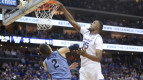
It’s worth noting that Arizona State is ranked. In men’s basketball. It’s an infrequent Tempe phenomenon but something that’s perhaps not all that shocking. There were glimpses a season ago, however, and the Sun Devils returned a number of critical pieces while adding that which they were missing. And what were they missing? Size. Or at least anyone capable of grabbing a rebound. The Devils ranked 313th and 292nd in defensive and offensive rebounding, respectively, in 2016-17. Sitting on their bench due to NCAA red tape, though, was perhaps the answer. Romello White, a four-star prospect, is through three weeks of the current season presenting as the Sun Devils’ missing piece. Arizona State isn’t necessarily any bigger in the aggregate, but the data suggests that a strategy of doubling down on small ball is paying off, thanks to White.
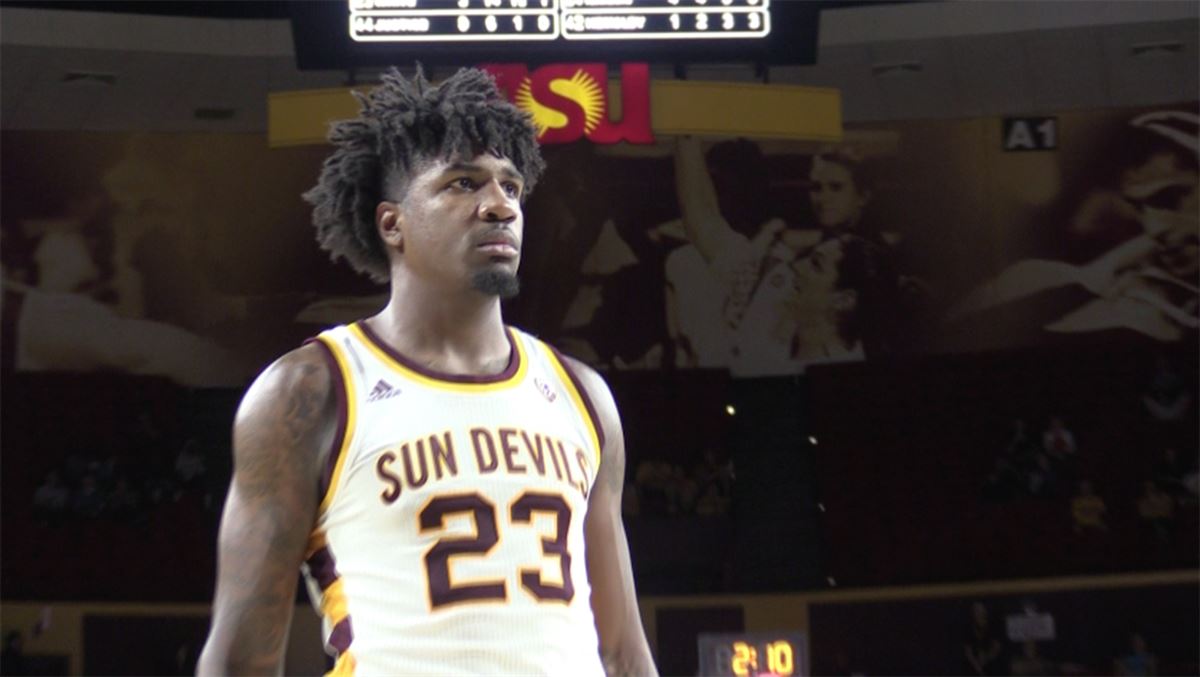
Romello White Has Been a Missing Frontcourt Piece for the Sun Devils (USA Today Images)

They’re nationally ranked now, after all, and touting the nation’s 10th most efficient offense. The Sun Devils are making 43 percent of their threes (nuts) and 63 percent of their twos (even crazier). Beyond that, they tout the nation’s fourth highest free throw rate (54%) — an astronomical improvement from last season’s 31.9% (273rd nationally) — and both Tra Holder (36% career three-point shooter) and Shannon Evans (also 36% career) are shooting well above their career averages. In missing a low post presence, White has emerged as the dynamic talent capable of catapulting the Devils to new heights. At 6’8”, the freshman is already rebounding above his weight (59th in defensive rebounding percentage) while simultaneously drawing 8.3 fouls per 40 minutes. And it’s not just his weight. Operating at equal levels of big-man effectiveness is De’Quon Lake, a junior college transfer brought in to fortify what was an abysmal frontcourt. It’s working. Lake’s numbers are on par, if not better than, White’s.
Read the rest of this entry »

Share this story

Five Key Big Ten Takeaways From a Dreadful ACC Challenge Week

Posted by Tommy Lemoine on December 1st, 2017

This year’s ACC/Big Ten Challenge was a wake-up call for the Big Ten, as the conference dropped 11 of the 14 contests, including five losses by more than 10 points. Its 3-11 mark represents the league’s worst record, by far, in the event’s 19-year year history. And while it’s only fair to judge a conference so much based on a single set of match-ups in November, there’s still reason to worry. Let’s examine a few of the most glaring takeaways, both good and bad, from the four-day drubbing.

Maryland’s loss at Syracuse was one of many for the Big Ten. (Rich Barnes-USA TODAY Sports)

  • The “best of the rest” might not be so great. Michigan State and Purdue were pegged #1 and #2 in the Big Ten preseason media poll, and both took care of business this week. The Spartans knocked off their second-straight top-10 ACC opponent, while the Boilermakers used a crowd-fueled second-half surge to defeat #17 Louisville. As for the remaining “upper echelon” squads? The ACC/Big Ten Challenge did not go very well. Preseason #3 Minnesotashorthanded, to be sure — lost at home to Miami (FL), unable to keep big man Dewan Huell (23 points) and the Hurricane guards from carving them up on the pick-and-roll. Northwestern, picked fourth, mustered just 0.88 points per possession in a buzzer-beating loss at Georgia Tech. Michigan and Wisconsin were soundly defeated on the road against North Carolina and Virginia, respectively, while Maryland — just three days after losing to St. Bonaventure — fell at Syracuse. While one could simply blame the bulk of these losses on bad match-ups, that would be ignoring the fact that several of these programs were unknown quantities heading into the season. The Terps lost Melo Trimble to the pros; Wisconsin and Michigan each lost three of their top four scorers to graduation; Northwestern hasn’t finished among the top four of the Big Ten since 1968. This week’s results may be nothing more than a few bad match-ups playing out in the ACC’s favor; then again, they may also be indicative of Big Ten that is not quite as deep — or simply as good — as some expected. At the very least, the one-sided outcome could do lasting damage to the conference’s seeding profile come Selection Sunday.

Read the rest of this entry »

Share this story

ACC Weekend Preview: December 1-3

Posted by Mick McDonald on December 1st, 2017

After overwhelming the Big Ten this week by a final tally of 11-3, the ACC now moves into a weekend that features a handful of very interesting non-conference tilts. (All ratings are via KenPom and statistics are through games of November 30)

Friday, December 1

  • North Carolina (#12) vs. Davidson (#77). Two of the highest-scoring teams in the country (both coming in at over 85.0 PPG) will face off tonight in Charlotte in what promises to be a very fast-paced affair. Tar Heels point guard Joel Berry II has improved his scoring (career-high 20.0 PPG) thanks to tempo and opportunity, but he is clearly still shaking off some rust from an early-season hand injury — logging career lows in shooting (34.1 FG% and 35.9% from three-point range). While his shooting should improve over time, he has been terrific in taking care of the ball (career-low 6.9% turnover rate) and will have an opportunity to find his touch against a Davidson team that is allowing opponents to shoot 38.4% from from behind the three-point line.

Saturday, December 2

Ahmed Hill has led a prolific Hokies offense early on. Can it continue as the competition picks up? (Hokie Sports)

  • Virginia Tech (#37) at Mississippi (#60).  A road contest at Ole Miss will represent the biggest challenge faced by Buzz Williams’ team so far this season. Both teams are guard-oriented and love to shoot the three, with the Hokies’ scorching 46.8 percent mark good for fourth nationally. With the caveat that Virginia Tech’s competition this far has been bad, not enough has been said about the play of Ahmed Hill this season. The junior wing is shooting the lights out, with marks of 63.9% FG, 54.3% 3FG and an insane 73.8% eFG. His elite offensive performance alongside guards Justin Bibbs and Nickeil Alexander-Walker has made Williams’ offense especially dangerous. Those three will need to outperform a loaded Rebels’ backcourt that features Terence Davis (61.8% eFG) and Deandre Burnett (45.2% 3FG).

Read the rest of this entry »

Share this story

Preaching Patience With Louisville and David Padgett

Posted by Chris Hatfield on November 30th, 2017

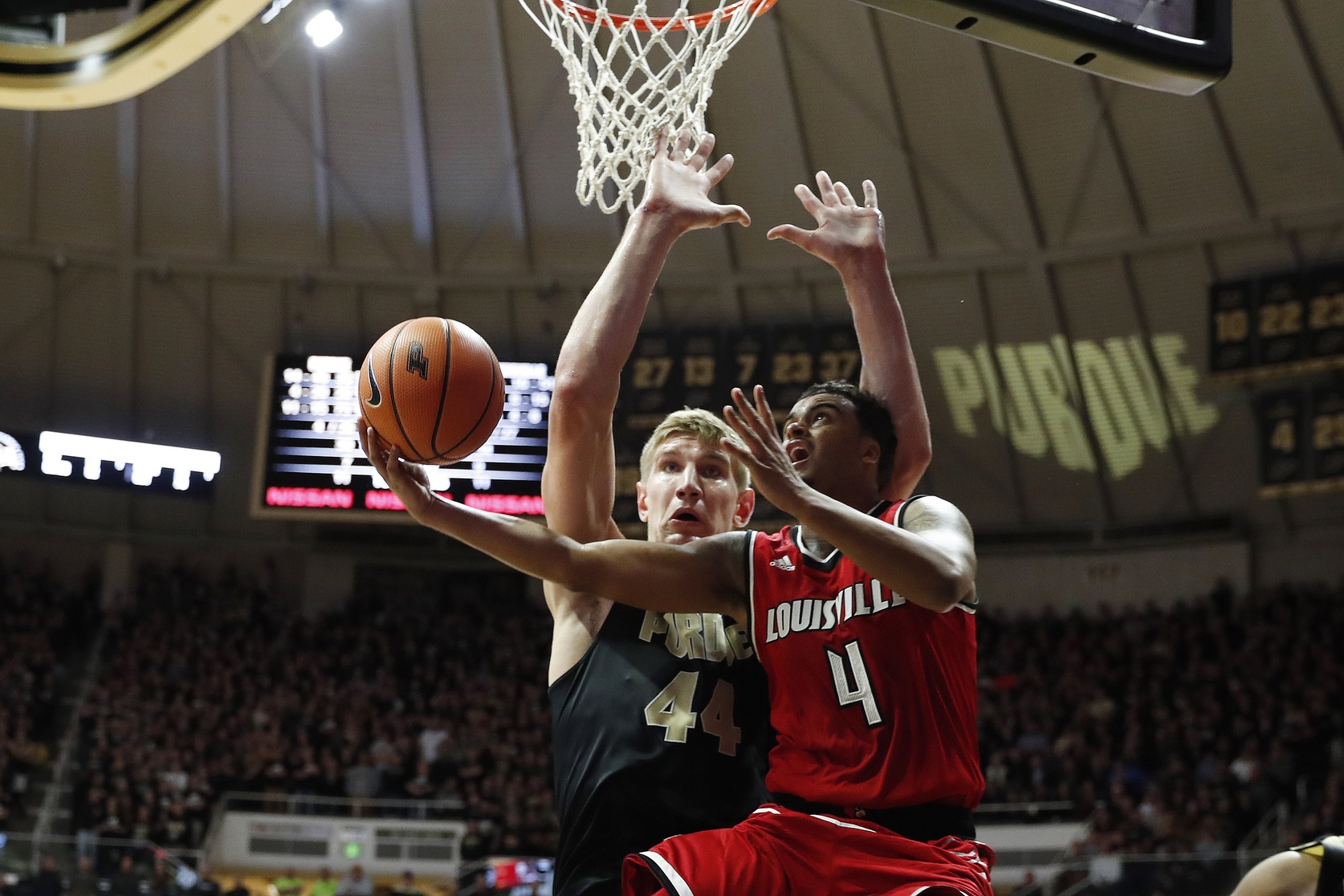
In the blink of an eye — 48 hours, can be a long blink, right?– David Padgett went from the “tall guy” on the coaching staff to the head coach of one of the premier jobs in all of college basketball. The quickness with which Padgett was thrown into the role perhaps became most apparent on Tuesday night this week, when Louisville lost at Purdue, 66-57, in the ACC/Big Ten Challenge. It was apparent in the sense that Louisville was bound to fail in the defining moments of the game — or maybe Padgett was. It represented the first time he was forced to make decisions in a hostile road environment. It was the first time he had to deal with significant foul trouble from his players. It was the first time he had to truly own the role of the head coach at the University of Louisville. He handled it all very well. There were things that could have gone differently, too. Still, an opportunity to learn on the fly needed to happen and a scenario where that learning ended in victory seemed impossible. This is life for the Louisville program after Rick Pitino: plenty of talent to make some noise this season with an equal number of reasons to fail to capitalize on it.

Louisville Fought Hard at Purdue But Came Up Just Short (USA Today Images)

Full disclosure: I walked into Mackey Arena expecting Louisville to get blown off the floor. That feeling was compounded when Padgett played a host of disoriented-looking freshmen during critical stretches. Instead, a few different bounces could have put the Cards in position to win the game. Still, the notion that Louisville is an above-average team with a sky-high ceiling wouldn’t dissipate. Its schedule to date has been weak (254th nationally), and Padgett’s team has failed to put together a full 40 minutes in all but one game (Southern Illinois). Luckily there is enough talent for the Cardinals to make expansive strides from now to March. Their performance at Purdue has already shown that they will be prepared in hostile environments, but the next step in that process will be about execution. Forthcoming match-ups against Seton Hall, Memphis and Kentucky in December will provide further evidence on how far Louisville has to go. Padgett welcomes the pressure and thinks those strides will be made. “It’s going to hurt. It should hurt. But I told our guys if you give me that kind of intensity and effort every night, we have a chance to be a special team.”

Read the rest of this entry »

Share this story

ACC/Big Ten Challenge Preview: Part IV

Posted by Brad Jenkins (@bradjenk) on November 30th, 2017

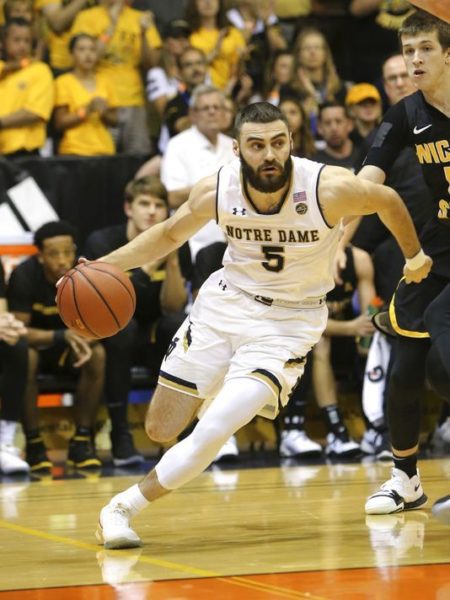
For the first time in its 19-year history, the ACC/Big Ten Challenge is being played over four days. With high profile schools such as Duke, Michigan State and North Carolina participating in last weekend’s PK80 tournament in Portland — which involved a handful of late Sunday night games — ESPN and the two leagues decided to push the event out an extra day rather than put all the marquee matchups on Wednesday. After three days of action, the ACC leads the challenge 11-2, clinching the overall event for the second year in a row in dominant fashion. Still, tonight’s finale between Notre Dame and Michigan State in East Lansing (ESPN – 7:00 PM ET) has a lot on the line for both teams. Here are some key storylines to follow.

Strength Against Strength: Notre Dame Offense vs. Michigan State Defense

Senior point guard Matt Farrell leads a talented Notre Dame offense into East Lansing to face the imposing Michigan State defense. (AP Photo/Marco Garcia)

The Fighting Irish come into this game with the fifth-best effective field goal percentage (60.4%) in college basketball, while the Spartans’ defensive rate (39.9%) ranks third nationally. Something’s got to give, right? It’s a little early in the season to make any sweeping statistical judgments, but perhaps it’s fair to gather predictive data from the few challenging games each school has played thus far. Notre Dame has faced one elite defense already — Wichita State in the Maui Invitational finals — and the Shockers held the Irish to a 52.9 percent effective field goal rate. Michigan State’s defense has faced two of the nation’s top-15 offenses (Duke and North Carolina) so far, holding both under 40 percent shooting on two-point shots. With that kind of rim-protection exhibited by Tom Izzo’s big men, expect the Irish to struggle to reach its normal shooting acumen.

Key Stat to Watch: Shot Volume

Read the rest of this entry »

Share this story

Florida Shows It Is Once Again Ready for Prime Time

Posted by David Changas on November 29th, 2017

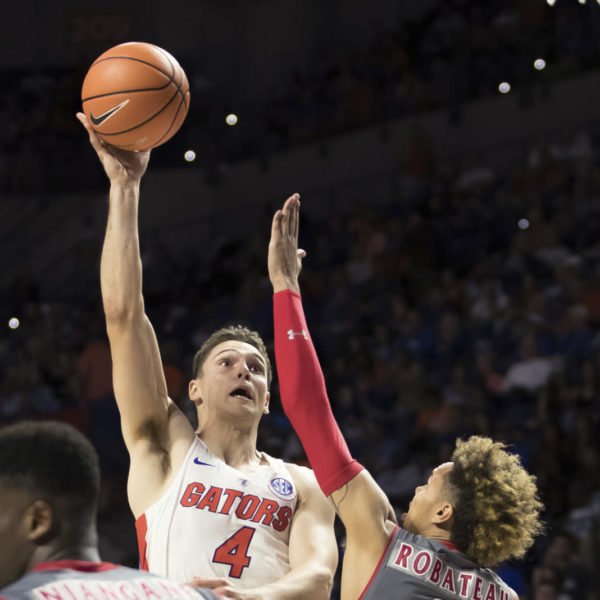
When Steve Spurrier arrived at Florida in 1990 to take over as the new head football coach for his alma mater, he instituted a progressive “fun ‘n’ gun” offense, which revolutionized the sport and eventually led to the previously moribund program taking over the SEC for the next decade. While the 2017-18 version of Florida’s basketball program is not doing anything revolutionary on the court, head coach Mike White has instituted his own version of the fun ‘n’ gun, and in so doing has made the Gators a must-see squad. On Sunday night, Florida was unable to hold a 17-point second half lead against top-ranked Duke in the PK80 event, but its performance in that game as well as a blowout win over Stanford and a thrilling double-overtime victory over Gonzaga drew plenty of attention.

Egor Koulechov has been even better than Florida could have expected. (AP/Ron Irby)

The up-tempo style that White has instituted has especially benefited two transfer wings – Jalen Hudson and Egor Koulechov — who lead the Gators in scoring at 21.8 and 17.5 PPG, respectively. The two have combined to shoot a blistering 47.9 percent from three-point range and to this point have far exceeded what White could have expected from the duo. Hudson played his first two seasons at Virginia Tech, where he averaged fewer than 10 points per game,; Koulechov, a coveted graduate transfer from Rice, picked up where he left off in averaging over 18 points per contest last year. Much was expected of the Gators with preseason all-conference selection KeVaughn Allen and underrated senior point guard Chris Chiozza returning, but what Hudson and Koulechov have added has taken Florida to an entirely different level. Read the rest of this entry »

Share this story

Analyzing Arizona’s Three Consecutive Losses

Posted by Adam Butler on November 29th, 2017

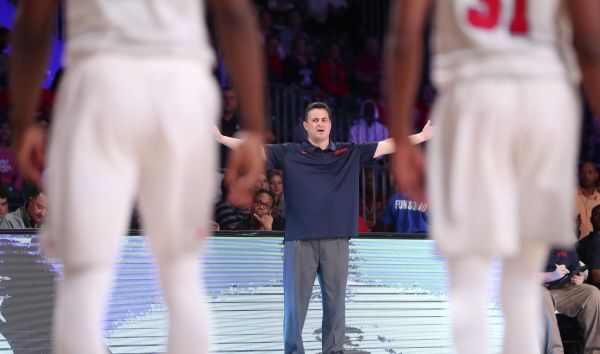
The approach to analyzing Arizona’s unprecedented fall from the Top 25 to unranked over the last week can take many approaches. There’s the physical — diving deep into lapses on the defensive end that yielded 90 points to NC State, the first 90-point effort by a Wildcats’ opponent since 2010. It was a point total Oregon didn’t achieve last year when the Ducks made 16 threes and shot 67 percent from the field. It’s a physical analysis that would also recognize offensive woes — everything from point guard play to offensive flow and scheme. There’s the emotional — dissecting an element of the game that’s difficult to view on tape or quantify, making note of the ongoing investigations or team dynamics. This would lead us down a path of deep hypothesizing and creating narratives about chemistry, priority and focus. We could also be self-reflective, recognizing the team’s performance but questioning our own ability to forecast or evaluate. Was the incoming freshman class just not that good? Have we undervalued Kadeem Allen? Is Allonzo Trier individually skilled but lacking in a team environment? Of course each of these analyses would be valid. Each would address legitimate concerns and each has been discussed, in depth, across the internets (read Rob Dauster’s breakdown). A dive into Arizona message boards or Arizona Twitter to find allusions to Sean Miller’s dismissal and misinformed rumors. Unprecedented events often yield ridiculous reactions (as does the internet, but you knew that).

Yep, it’s been that kind of start for Sean Miller’s Wildcats. (Kevin Jairaj/USA TODAY Sports)

I’d focus any analysis on the word TRUST. Arizona entered the season as a favorite with known limitations and hopeful improvements. Parker Jackson-Cartwright is a skilled guard. He can hit an open shot, handle and pass the ball effectively and understands the complex pack-line defense. His size and athleticism, a known deficiency, can be a detriment to what Arizona is trying to accomplish on the defensive end (stopping dribble penetration) and the offensive end (threatening in transition). What’s worse, PJC can disappear, a significant issue for a senior point guard. For him, it’s a matter of consistently TRUSTING his ability. Conversely, Trier seems to have no issue in trusting his abilities. Touting a top 100 usage rate (29%), Trier is of the belief he’ll lead this team by carrying it on his back. Sometimes, that’s OK. More specifically, however,  when that’s not working, it’s not OK. For Trier there would seem to be an issue of TRUSTING his teammates, a skilled lot that will help him achieve his, and more critically the team’s, goals. And speaking of the collective, to borrow Miller’s terminology, they’ll need to TRUST the process, a tagline that has been central to this program. A tagline that has yielded 223 wins in Miller’s time in Tucson (averaging 28 wins per season). Three consecutive losses are a drop in the procedural bucket, an opportunity to teach, learn, coach, galvanize. Arizona’s team and program is far bigger than a Bahamian disaster. Read the rest of this entry »

Share this story

Despite Four Losses, It’s Far Too Early to Lose Faith in Wisconsin

Posted by Tommy Lemoine on November 29th, 2017

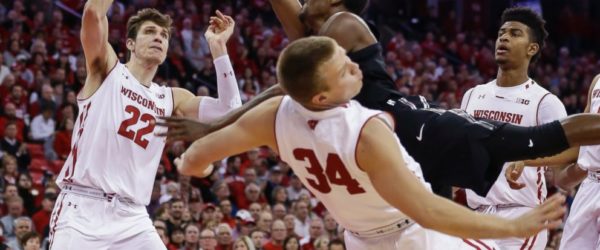
Wisconsin’s ACC/Big Ten Challenge loss to Virginia on Monday — its fourth defeat of the young season — rounds out the program’s worst month of November since 2002, when the Devin Harris-led Badgers lost to Weber State and Hawaii en route to a 3-6 start. This season, close defeats at the hands of Xavier, Baylor and UCLA, along with this week’s poor showing in Charlottesville, has left some wondering whether Wisconsin simply doesn’t have the firepower to remain a top-tier challenger in the Big Ten. After all, most programs don’t lose four heavily-used seniors and simply bounce right back. But Wisconsin isn’t like most programs. With Ethan Happ looking every bit the Big Ten Player of the Year candidate he was pegged to be and a key freshman emerging in the backcourt, the Badgers — one of the most consistent programs in college basketball — should still be viewed as a contender. Especially with the history that’s on their side. 

Ethan Happ and Brad Davison should keep the Badgers competitive. (AP Photo/Andy Manis)

The prevailing narrative for Wisconsin entering 2017-18 was that Happ, its ultra-skilled big man, would have to shoulder a massive load for the Badgers to be successful. “Now he’ll have to be even better,” the Wisconsin State Journal recently said, referencing the fact that Happ would need to improve upon his already-great 2016-17 campaign. Luckily, early results suggest the junior is more than up to the task. Through seven games, Happ is averaging 17.6 points, 9.1 rebounds, and 3.1 assists per night, posting an offensive rating (111.8) and shooting percentages on par with last year despite playing more minutes and using more possessions. He currently ranks third in KenPom’s Player of the Year standings, and his second-half scoring surges against Xavier and Baylor were key to the Badgers staging late-game (if ultimately unsuccessful) comebacks. Perhaps most impressive so far has been Happ’s ability to distribute the basketball. Often serving as a point forward in and around the paint, Happ currently boasts an assist rate (26.5%) that would make most point guards jealous. The notion that “Wisconsin will only go as far as Happ takes them” sounds far less scary now that the junior appears fully capable of carrying that heavy load. Read the rest of this entry »

Share this story

Trae Young Leads Salty Sooners Back on to the National Radar

Posted by Brian Goodman on November 28th, 2017

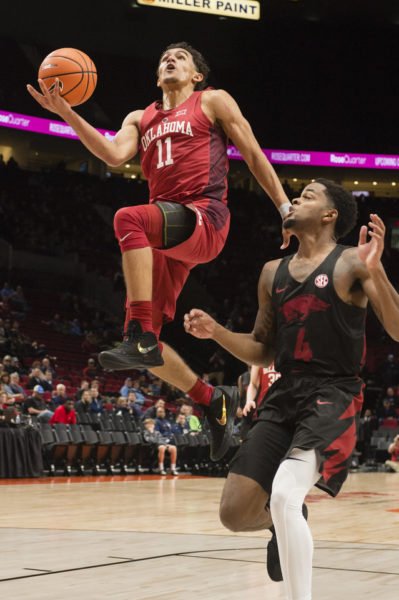
When Oklahoma lost Buddy Hield, Ryan Spangler and Isaiah Cousins after their trip to the 2016 Final Four, the Sooners predictably dropped off. They were better than their 11-20 overall record last year suggested, but you couldn’t fault anyone for tuning them out as it quickly became clear that a return to the postseason wasn’t in the cards. Just one season later, though, Lon Kruger‘s team is right back to putting up explosive numbers with one of the country’s best guards leading the way. To be clear, freshman point guard Trae Young and the former NPOY Hield are vastly different players, even aside from their different track records. Whereas Hield made most of his hay off the ball, Young is a more balanced offensive threat possessing savvy court vision to boot. In the early going, though, Young is showing that he could have a similarly memorable campaign in Norman.

After an off-year in 2016-17, Oklahoma is back among the most exciting teams in college basketball. (AP Photo/Troy Wayrynen)

Facing legitimate competition for the first time this season, Young balled out at the PK80 event in Portland, averaging 34.7 points per game across three tilts against Arkansas, Portland, and Oregon, while putting up a hyper-efficient 70.8 percent true shooting percentage. The freshman has excelled everywhere on the floor — shooting 38.6 percent from three-point range, 57.1 percent inside the arc, and 89.4 percent at the free throw line. For greater context, his 8.0 fouls drawn per 40 minutes dwarf Frank Mason’s clip of 5.5 per 40 last season, and he’s making his opponents pay at the stripe. Young’s aggression while leading the third-fastest offense in the country occasionally backfires in the form of a bad pass or ill-advised shot, but those miscues haven’t yet been detrimental to the Sooners, nor are they currently keeping him from occupying the top spot in KenPom’s National Player of the Year rankings.

Read the rest of this entry »

Share this story

Get to Know Minnesota’s Jordan Murphy Before Everyone Else

Posted by Chris Hatfield on November 28th, 2017

Who expected this? Certainly not the media members who failed to vote for Minnesota junior forward Jordan Murphy on any of their preseason All-Big Ten teams. Probably not Richard Pitino, the head coach who talked often — and usually glowingly — about stalwarts Nate Mason, Isaiah Washington and Amir Coffey during the preseason, but not Murphy. Certainly not myself, who picked the Gophers as a Final Four team in the preseason, but did not believe Murphy would be a leading reason why.

Minnesota’s Jordan Murphy Has Been a Star This Season (USA Today Images)

Despite all that, Murphy’s name is slowly becoming more familiar across the college basketball landscape. The 6’6″, 250-lb. power forward isn’t on many mock NBA Draft boards because of his undersized frame, but if he continues to dominate everything in his path, he will find his way there too. He is averaging a double-double (22.0 PPG, 12.3 RPG) and has been consistent in his output, logging seven double-doubles in seven games — something even Duke standout freshman Marvin Bagley hasn’t accomplished. He’s also currently the second most efficient player in college basketball with a 37.9 efficiency rating, according to Sports-Reference, trailing only Notre Dame’s Bonzie ColsonThere are few individual statistical categories in which he is not within the national top five, especially on the offensive end of the floor. He’s been everything the Gophers have needed and more than they could have ever wanted.

Efficiency is His Calling Card

Read the rest of this entry »

Share this story