

Olympic Basketball as an Under-23 Affair: Who Are the Top Candidates for 2016?

Posted by EJacoby on June 22nd, 2012

In the 20th anniversary year of the original 1992 ‘Dream Team,’ USA Basketball is once again sending a team of elite NBA players in search of the 2012 gold medal. But could this become the final time we see such a collection of professional stars? Rumblings over the past few weeks from all corners of college, pro, and international basketball suggest that Team USA will instead send younger players to the Olympics, perhaps through the old school method of all amateurs or rather in a new combination of college and young pros. The most likely scenario includes an all Under-23 squad, resembling the way the USA selects for its Olympic soccer teams. CBS Sports’ Matt Norlander, among others, has highlighted what Team USA would look like this year if it was an Under-23 team. But any new method would not take place until the next Summer Olympics in 2016, so what would that team potentially look like? In order to qualify for the Under-23 team four years from now, only players who are 19 or younger right now could be under consideration. Today we take a look at some of the best candidates, considering both current accomplishments and potential future growth.
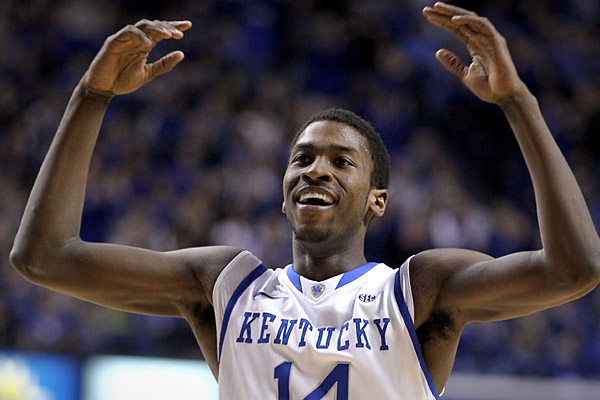
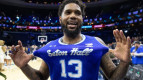
Michael Kidd-Gilchrist would qualify for the 2016 Olympics if Team USA goes with an Under 23 approach (AP Photo)

A quick 15-man list of the top 19-or-younger players goes as follows:

  1. Anthony Davis
  2. Tony Wroten
  3. Michael Kidd-Gilchrist
  4. Bradley Beal
  5. Andre Drummond
  6. Quincy Miller
  7. Nerlens Noel
  8. Shabazz Muhammad
  9. Cody Zeller
  10. James Michael McAdoo
  11. Kyle Anderson
  12. Jabari Parker
  13. Julius Randle
  14. Andrew Harrison
  15. Andrew Wiggins

Read the rest of this entry »

Morning Five: 06.22.12 Edition

Posted by rtmsf on June 22nd, 2012

  1. Last night marked the end of another season of basketball as the NBA crowned its newest champion, the Miami Heat, and we now head into a four-month dry spell without competitive hoops (the Summer Olympics next month will provide a brief respite). While the evening definitely belonged to LeBron James’ coronation as one of the all-time greats, a pair of his role player teammates joined the short list of players to have won both a national title in college as well as a world title in the NBA. With the Heat’s victory, Kansas’ Mario Chalmers (2008) and Duke’s Shane Battier (2001) have now pulled off the twin feat, increasing the the total number of NBA champs with at least one NCAA champion in its regular rotation to an astonishing 71 percent. Battier in particular has long been considered a more valuable player than his numbers might suggest, but it’s no great secret to suggest that winning players tend to find their ways onto winning teams. Congratulations to Battier, Chalmers, James and the rest of the Miami Heat for their 2012 world championship.
  2. While on the subject of the NBA, it appears that ESPN analyst Jalen Roseis set to become the Gameday replacement for Hubert Davis next season. We’ve said this before, but the metamorphosis of Rose from Fab Five hothead to a solid ESPN analyst is nothing short of phenomenal. Unlike Davis and most of the Gameday crew, Rose isn’t afraid to mix it up a bit — Digger Phelps taking ridiculous positions for the sake of comedy notwithstanding — and could serve to enliven a group that has a tendency to act non-confrontational. From the same article, TBL suggests that former Virginia Tech head coach Seth Greenberg will become a college basketball analyst on the WWL next season as well, with an eye toward replacing Phelps when he finally decides to retire.
  3. We expect to have another post on this topic up later today, but Matt Norlander at CBSSports.com writes that the APR rule which will keep 10 programs out of the postseason in 2012-13 could have a significant deleterious effect on the future of the game if schools don’t take it seriously. The key point is that as many as 60 schools could have been kept out of next year’s postseason if the APR floor of 930 was already in effect (as it will be in 2015). Some of those schools include names like Oklahoma State, Providence, Oregon, Auburn, Arkansas and LSU, and while none of those carry the cachet of Connecticut, the reality of it suggests that a one- or two-year drop in significant academic performance could in fact knock big-time programs such as UCLA or Michigan State out of the NCAA Tournament in some future year. The NCAA has already shown through its refusal of UConn’s appeal that it has no interest in providing exceptions, so this is something everyone involved with college basketball at the ground level will have to carefully monitor.
  4. Louisville announced on Thursday that former rising star forward Rakeem Buckleswill transfer to play for Rick Pitino’s son, Richard, at FIU for his final season. The hard-luck player has suffered a conga line of injuries after a promising freshman year in 2009-10 that ended with him going for 20/9 in an NCAA Tournament loss to California. His sophomore and junior seasons were both cut short by ACL injuries, and he is expected to miss the entire 2012-13 season recovering from his latest ligament tear. Louisville appears to be loaded at his position going into the next two seasons, so we’re sure that Buckles viewed this transfer as an opportunity to head closer to home and find some playing time in a comfortable situation to finish his career.
  5. In clearly one of the great disappointments of this offseason, West Virginia’s hirsute Deniz Kiliclihas decided to shave off his trademark mountain man beard. Citing the summer heat in Morgantown as the primary reason for his shearing, we hope that he allows for plenty of time to bring it back next fall. Right around October 15 is fine with us. Only 112 days now…

A Beardless Kilicli: The Horror, The Horror…

Rough Offseason Has UConn Reeling, But Team Remains Hopeful in 2012-13

Posted by EJacoby on June 21st, 2012

Breaking news surfaced on Wednesday when the NCAA released its Academic Progress Report (APR) for all Division I athletic programs, and a whopping 10 men’s basketball teams are now banned from the 2012-13 NCAA Tournament after failing to reach the required APR average score of 900 over the last four years. The biggest name on the list, and the only power conference school to ever receive a postseason APR ban, is Connecticut, which recorded a four-year score of 889. But none of this was news to the Huskies, a school which had already lost an appeal this offseason for inclusion. The postseason ban is just one of many pieces of bad news that UConn has received this offseason, which has put the future of UConn basketball in serious doubt. Your 2011 National Champions have struggled on and off the court since that wild run two springs ago sparked by Kemba Walker and company. Transfers, violations, firings, underperformance, and bans have dominated the news cycle around Storrs and 70-year-old future Hall of Fame head coach Jim Calhoun remains on the fence about coaching his team for much longer. Where does UConn go from here, and what can we expect from the Huskies on the court next season?

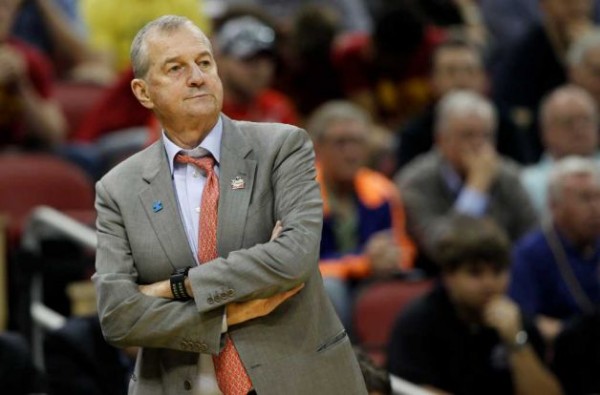
Jim Calhoun’s future remains in doubt, but the Hall of Fame coach doesn’t want to leave the program in chaos (AP Photo)

Connecticut basketball has been nothing short of a disaster since hauling the National Championship trophy two seasons ago. While that year’s historic run of 11 straight postseason wins is forever engrained in Storrs lore and perhaps fans can accept a few years’ grace period after winning a title, it’s still hard to believe how quickly things have fallen. UConn entered 2011-12 as the Big East preseason favorites but struggled to a 20-14 finish, playing through multiple suspensions and the extended absence of Calhoun due to rules violations and health reasons. The team lost its first round NCAA Tournament game to Iowa State in convincing fashion, and things have only gotten worse since that game in March. Top talents Jeremy Lamb and Andre Drummond both declared for the NBA Draft, and forwards Roscoe Smith, Michael Bradley, and Alex Oriakhi all transferred out of the program, leaving major holes in the roster. The team is ineligible for both the 2013 Big East and NCAA Tournaments after poor academic performances in the past four years. Recruiting has been understandably difficult, as the school remains a questionable short term destination for prospects. There’s a brand new athletic director (Warde Manuel) on campus who has yet to implement his long-term strategy. And perhaps most importantly, Calhoun remains uncommitted to his future on campus. The 70-year-old has two more years left on his contract and certainly does not want to leave the program in chaos, but the future Hall of Famer will probably not stick around much longer no matter what situation the team is in.

Read the rest of this entry »

Morning Five: 06.21.12 Edition

Posted by nvr1983 on June 21st, 2012

  1. Connecticut bumped up its APR score to 978 for 2010-11 season, but as we all know it was too late for the Huskies as they along with nine other schools have been banned from the 2013 NCAA Tournament. The Huskies, who are by far the most high-profile team to be banned, were brought down by scores of 909, 844 and 826 between 2007 and 2010. None of this is news to any of us, but what is interesting is how the NCAA is claiming that its academic reforms are a success based on a rise in APR scores in men’s basketball, football, and baseball. While this shows that schools are doing a better job at achieving higher scores it does not prove that they are doing a better job at producing individuals who can contribute to society. In fact, their use of APR to measure the success of academic reform and impact on the lives of student-athletes reminds us of the classic management article “On the folly of rewarding A, while hoping for B”.
  2. With the ridiculousness of conference realignment one of the voices we have not heard enough from is the commissioners of the conferences particularly the smaller more vulnerable conferences. Siena Saints Blog was able to secure an interview with Rich Ensor, the MAAC Commissioner, and asked him some questions about the impact of realignment, his conference’s future, and their role in the college basketball landscape. Ensor does not deliver any shocking revelations, but he does appear to answer the questions in an honest, straightforward manner, which is more than we can say for many of the other individuals involved in similar situations.
  3. The new NCAA rules allowing increased contact between coaching staffs and recruits was supposed to foster an era of more openness while also decreasing the chances of infractions being committed although to some it would be like saying that speeding violations would decrease if you would just raise the speed limit. One family that has not bought into the idea of having more contact with colleges is the family of Jabari Parker, the #1 recruit in America. Parker’s family, whose protective strategies we have detailed here before, is not even giving out Parker’s number to colleges as the colleges have to go through the family before they can talk to the star recruit.
  4. The 2012 NBA Draft is just one week away and while most people are looking forward to the upcoming Draft, Matt Norlander is looking back at the last decade’s worth of Drafts. Going through the 117 schools that have had players drafted during the time he notices some rather distinctive trends for certain schools and conferences. The blue bloods continue to churn out multimillionaires, but the numbers for the various conferences and some schools in particular may surprise you.
  5. We have not commented on the Under 18 basketball team competing in 2012 FIBA Americas U18 Championship mostly because they have been so dominant, but after winning the final by a score of 81-56 over Brazil it is time to recognize their play. Composed of many of the top incoming college freshmen next year, but missing the consensus top two players in the class, Team USA dominated its opposition and improved its record to 43-2 all-time in the tournament. We don’t think you should make too much of this because from what we have heard the opposition was not that good (sorry, we are not experts on teenage basketball in Central and South America) and frankly this group of incoming freshmen is not supposed to be as talented as last year’s group so although this does not signal a return of the dominance of US basketball at the grassroots level it is a nice accomplishment for the group.

CAA Decision Shows Why Conference Realignment is More Complex Than You Think

Posted by EJacoby on June 20th, 2012

With a number of schools changing conference affiliation every six months or so, conference realignment remains a dominant factor in the college basketball landscape. Will the Big East soon lose its distinction as the most consistently good hoops league to the ACC? Perhaps so, given that three of the league’s premier teams – West Virginia, Syracuse, and Pittsburgh – will have departed for new conferences after next year, the latter two headed south to the ACC. It begs the question why some schools even consider sticking with their current leagues if they have offers on the table to join a more flourishing conference or – for the mid-majors of the world – the Atlantic 10. But Tuesday’s news that the CAA will disallow departing schools Georgia State and Old Dominion from competing for a conference championship next season sheds some light on the drawbacks of bolting for greener pastures. Not only will these two schools be forced to pay a hefty exit fee of $250,000, but both must wait out a lame duck season in their current leagues without a chance to play for a conference championship. This is especially detrimental to the Monarchs, a team which finished fourth in the CAA last season and should have another good team next year. ODU essentially will waste a year of basketball competition that could significantly affect player focus and development and potentially result in transfers from young players who don’t want to wait two or three seasons for its transition to Conference USA to run smoothly.

Blaine Taylor’s ODU Monarchs won’t have much to play for in the CAA next season (AP Photo)

As we mentioned earlier in today’s Morning Five, it’s been surprising that other conferences haven’t imposed similar restrictions on departing schools. How crazy would it be if Syracuse and Pittsburgh were unable to compete in the Big East Tournament next season? The CAA has a long-standing rule that migrating schools are not allowed to compete in their postseason tournament, and conference commissioner Tom Yeager says that the universities fully understood the punishments when they decided to bolt. “The conference bylaws were well understood and evaluated when the institutions made their decision to withdraw from the conference,” he said. “We desire to have those institutions that are fully invested in the continued prosperity of the conference represent the conference as its champion.” So now, unless ODU puts together one of the 37 most impressive at-large resumes in hoops next season (highly unlikely), the Monarchs won’t have a realistic shot at the Big Dance despite a flourishing young roster. This puts in perspective how fortunate VCU is to have received immediate acceptance into the Atlantic 10. The Rams won one, and nearly two, games in the NCAA Tournament last season after winning the CAA Tournament (firmly on the bubble at the time). Shaka Smart’s team likely would not have qualified for the Big Dance had it not have played so well to win the league tourney.

Read the rest of this entry »

RTC NBA Draft Profiles: Perry Jones III

Posted by dnspewak on June 20th, 2012

The NBA Draft is scheduled for Thursday, June 28, in New York City. As we have done for the last several years, RTC’s team of writers (including Andrew Murawa, Kevin Doyle, Evan Jacoby, Matt Patton, and Danny Spewak) will provide comprehensive breakdowns of each of the 35 collegians most likely to hear his name called by David Stern in the first round on draft night. We’ll generally work backwards, so for the next week or two we’ll present you with players who are projected near the end of the first round, and we’ll work our way up into the lottery as June progresses. As an added bonus, we’ll also bring you a scouting take from NBADraft.net’s Aran Smith at the bottom of each player evaluation.

Note: Click here for all published 2012 NBA Draft profiles.

Player Name: Perry Jones III

School: Baylor

Height/Weight: 6’11”, 235 lbs.

NBA Position: Power Forward

Projected Draft Range: Mid-First Round

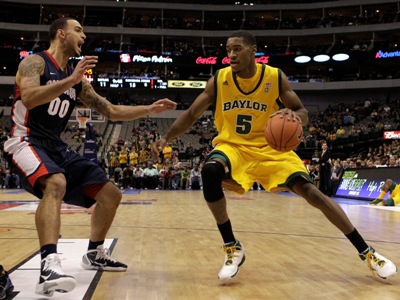
Perry Jones: Enigma Wrapped in a Riddle (AP)


Overview: There has been no greater enigma in college basketball than Perry Jones III during the past two seasons. When he first arrived at Baylor, it seemed implausible he would stay for more than just one year. By all accounts, he was supposed to be the next Kevin Durant or Michael Beasley in the Big 12, a guy who lights up the league for five months and then bolts for the pros. That type of stardom never materialized for him as a freshman, though, and Jones returned to Waco and played frustratingly modest for a second straight season in 2011-12. Once considered an obvious top five NBA Draft selection, scouts continued to criticized Jones for not asserting himself physically and not playing “big” enough. He shined at times during the 2011-12 season, but he also faltered in match-ups against Kansas’ Thomas Robinson, Missouri’s Ricardo Ratliffe and other elite big men like Kevin Jones (West Virginia) and Arnett Moultrie (Missisippi State). It was a tale of inconsistency all season long. He lit up for Kentucky for 17 points in the Elite Eight but scored only two against South Dakota State in the second round; he embarrassed Kansas State with 31 points in the Big 12 quarterfinals but fouled out with four points in 22 minutes against the Wildcats in February. Overall, Jones had a successful season and two-year college career, but outside expectations are insanely high for this young man. So much that it may have been impossible for Jones to ever reach his full “potential” in college.

Read the rest of this entry »

Track Record Suggests Dunlap Can Succeed In A Difficult Situation With Bobcats

Posted by EJacoby on June 20th, 2012

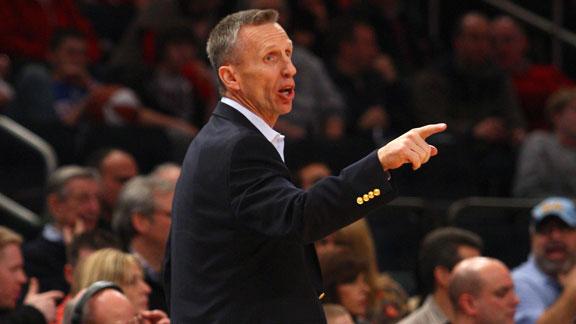
Mike Dunlap did an admirable job leading St. John’s as its unexpected interim coach last season to a 6-12 record in the Big East with an extremely young roster. Starting five freshmen for much of the conference season, Dunlap never complained about the tumultuous situation surrounding his team that lost coach Steve Lavin to health issues as well as several players to ineligibility or transfer. He was considered a major asset in the young players’ developments last season and heading into next year, but it was a major shock when Dunlap was announced on Monday as the new head coach of the Charlotte Bobcats. NBA analysts were completely caught off guard, immediately pointing out that Dunlap has never been a head coach at the Division I college level or in the NBA. The detractors should consider his previous history in challenging situations such as the one he will face with the Bobcats, a team that just finished 7-59 for the worst winning percentage in NBA history. Dunlap has twice before stepped into tough spots as an interim head coach and got young players to buy in. He did it first in 2008-09 at Arizona when Lute Olson stepped down early and then last season with St. John’s. Highly regarded in terms of player development and game strategy, Dunlap is a better fit than some other big names despite his lack of professional experience.

Mike Dunlap has impressed everywhere he’s worked as an assistant in the past (Getty Images/M. Layton)

After a decade coaching Division II Metro State, a stint that included two National Titles, Dunlap has bounced around several notable teams as a highly-regarded top assistant, including with the Denver Nuggets from 2006-08 under George Karl. And Karl, the future Hall of Famer, shared some terrific praise of Dunlap when he heard his former assistant got the Bobcats job. “[He’s] probably the most intelligent guy I ever talk to about the game of basketball,” said Karl. “Mike provides insight that I’ve never had anybody deliver. When you talk to him off the court, he could be Socrates. On the court, he’s an intense, competitive SOB.” It’s these kinds of recommendations from his prior stops that got Dunlap on Charlotte’s short list. For a team that struggled so badly and doesn’t have much talent or ego to deal with, the Bobcats needed someone willing to work endlessly in search of developing young talent. “To hire a guy of knowledge and character and service more than spin and perception is something that makes me feel great,” added Karl. When you think about it that way, Dunlap seems like a progressive hire by the Bobcats, a team that’s made such a mistake with these moves in the past.

Read the rest of this entry »

Morning Five: 06.20.12 Edition

Posted by rtmsf on June 20th, 2012

  1. There are many coaching hires where the logical process makes normal and complete sense to everyone – a longtime assistant is promoted to the top job; a big personality moves on to a school to match his ego; a mid-major guy is looking for more resources and talent. Occasionally, though, a random hire has everyone around the industry scratching his head wondering what they missed. It’s not very often that you’ll see a career assistant coach — mostly at the collegiate level, at that — make the jump to NBA head coach, but that’s exactly what St. John’s assistant Mike Dunlap did this week. Other than a handful of games when head coach Steve Lavin was out with prostate cancer last season, Dunlap has spent the last six seasons as an assistant, and the extent of his head coaching experience came at Division II Metro State from 1997-2006. Dunlap reportedly beat out more prominent names such as Jerry Sloan, Brian Shaw, and Quin Snyder for the position, and although according to Jeff Goodman everyone knows he can coach, this is a real gamble on the part of the GOAT as part owner of the Charlotte Bobcats.
  2. If a player only sets foot on your campus for the better part of eight months, is it OK for an alumnus to claim that star as one of his own? That’s the question posed by Grantland’s Bryan Curtis as a Longhorn considering the provenance of one Kevin Durant, one of the NBA’s brightest stars but a player who probably wasn’t around Austin long enough to even witness the bats on Congress Avenue Bridge. Curtis ultimately settles on the answer “yes,” – shocking, we know – but he actually digs up some thoughtful and relevant examples of other prominent Texas grads who were early entries into the work force well before it was fashionable. A couple of those names? Walter Cronkite and Michael Dell.
  3. Stop the presses, but Fab Melo has decided to speak about his suspensions last season at Syracuse. If you recall, the Big East DPOY was suspended twice during the season, including a devastating NCAA Tournament suspension that essentially killed the Orange’s realistic chances at a national title. The reason: (drum roll) academics. Melo is touring around the country in an effort to improve his draft stock, and he decided to talk about his time away from Jim Boeheim’s team during his sophomore year this week. To wit, “They ask, I explain (what) happened — that I came from another country and until four years ago didn’t even speak English.” This is all fine and well, but if we were an NBA scout, we might be willing to look past one indiscretion — but dropping the ball during the most important month of his collegiate career is an altogether different story. Did he forget how to stay eligible between the first part of his sophomore year and his second? Or did he realize he was going to be a millionaire soon and decided to stop caring about classes? That’s the question that should be asked — whether the answer is relevant to his future prospects as a ball player isn’t for us to decide.
  4. With all the bad blood surrounding conference realignment, we’re actually surprised that we haven’t seen what the CAA has decided to do more often. The league announced on Tuesday that departing members Old Dominion and Georgia State – both of which will remain in the league in 2012-13 – will not be eligible to compete for conference championships next year. The CAA’s Council of Presidents voted unanimously to uphold a longstanding rule meant to dissuade schools from jumping ship. VCU, which will join the Atlantic 10 next month, will obviously not be impacted, but this goes to show that conference realignment at its core is something of a bloodsport, and memories of such influential people at the highest levels tend to not easily erase.
  5. We sorta love it when in-state rivalries are exacerbated through the local media, and NC State is only the latest and greatest to use the old standbys — billboards and television ads — to make declarations of grandeur based on nothing more than marketing, spit, and perhaps a little duct tape. Whether you measure it by success or fans, there’s virtually no possible way to justify an assertion that the great state of North Carolina belongs to NC State, but hey, whatever gets the juices running (and it’s still funny). Of course, even if NC State has won the last 10,000 football games against UNC, Duke, and Wake Forest combined, that’s still not what matters in the Tar Heel State any more than Auburn beating Alabama in basketball matters a lick. Kudos to NC State for giving it a shot, but nobody is fooled.

RTC NBA Draft Profiles: Kendall Marshall

Posted by EJacoby on June 19th, 2012

The 2012 NBA Draft is scheduled for Thursday, June 28, in New York City. As we have done for the last several years, RTC’s team of writers (including Andrew Murawa, Kevin Doyle, Evan Jacoby, Matt Patton, and Danny Spewak) will provide comprehensive breakdowns of each of the 35 collegians most likely to hear his name called by David Stern in the first round on draft night. We’ll work backwards, starting with players who are projected near the end of the first round before getting into the lottery as June progresses. As an added bonus, we’ll also bring you a scouting take from NBADraft.net’s Aran Smith at the bottom of each player evaluation.

Note: Click here for all published 2012 NBA Draft profiles.

Player Name: Kendall Marshall

School: North Carolina

Height/Weight: 6’4” / 195 lbs.

NBA Position: Point Guard

Projected Draft Range: Late Lottery / Mid-First Round

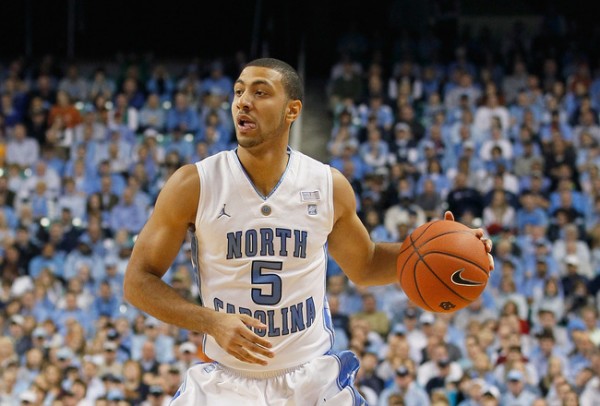
Kendall Marshall was the best passer in college basketball (Getty Images/K. Cox)

Overview: Kendall Marshall was the best passer in college basketball by a wide margin during his two seasons at North Carolina; only Iona’s Scott Machado came close to Marshall as a distributor. Marshall has elite floor awareness as well as a special ability to read defenses, and his pass-first mentality led to tremendous assist numbers playing alongside several great players at UNC. His 9.8 assists per game, 44.5% assist percentage, and 3.5 assist-to-turnover ratio as a sophomore all ranked second in the country. He led the Tar Heels to a #1 NCAA Tournament seed and was the team’s most indispensable player. After he broke his wrist late in a round of 32 win against Creighton, the Marshall-less Heels barely hung on to beat #13-seed Ohio in overtime in the Sweet Sixteen before falling to Kansas in the Elite Eight. Some people view Marshall as a ‘one-trick pony’ because he doesn’t do much else well besides passing the ball (8.2 PPG, 2.6 RPG). He also lacks the explosiveness that most NBA point guards have these days, and he really struggles defensively with limited lateral quickness. But his athletic demise seems exaggerated, as Marshall has great size (6’4”) and a strong body for a point guard and actually displayed some interesting driving and finishing ability at the rim. He wasn’t asked to create his own offense at UNC and didn’t look comfortable when he did so; he didn’t shoot the ball with confidence and simply preferred to pass to teammates in all situations. But he came on strong at the end of the season and showed some scoring prowess, plus he had decent season-long shooting numbers (46.7% from the field, 35.4% from three, 69.6% from the line). There’s untapped scoring potential in Marshall if he works hard in that area.

Read the rest of this entry »

RTC NBA Draft Profiles: Dion Waiters

Posted by EJacoby on June 19th, 2012

The 2012 NBA Draft is scheduled for Thursday, June 28, in New York City. As we have done for the last several years, RTC’s team of writers (including Andrew Murawa, Kevin Doyle, Evan Jacoby, Matt Patton, and Danny Spewak) will provide comprehensive breakdowns of each of the 35 collegians most likely to hear his name called by David Stern in the first round on draft night. We’ll work backwards, starting with players who are projected near the end of the first round before getting into the lottery as June progresses. As an added bonus, we’ll also bring you a scouting take from NBADraft.net’s Aran Smith at the bottom of each player evaluation.

Note: Click here for all published 2012 NBA Draft profiles.

Player Name: Dion Waiters

School: Syracuse

Height/Weight: 6’4” / 215 lbs.

NBA Position: Shooting Guard

Projected Draft Range: Mid-First Round

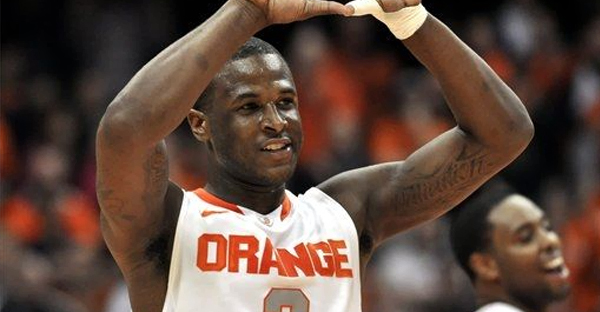
Dion Waiters Shows No Fear on the Floor, Which Should Help Him in the NBA (AP Photo/K. Rivoli)

Overview: Dion Waiters’ disappointing first year at Syracuse included a falling out with Jim Boeheim and contemplations about whether to leave the program. But the former top 20 recruit came back a completely different player in year two, where he was arguably the best and most impactful player on an elite Syracuse team. Waiters didn’t start a single game as a sophomore but was a game-changing reserve who could score points in bunches (12.6 PPG) and cause havoc with his perimeter defense (1.8 SPG). A player whom Boeheim said after his first year “played no defense last year – none” turned into the leading catalyst of the nation’s top team in steals. Waiters is a bully at 6’4” and 215 pounds who overpowered weaker defenders on his drives to the basket, leading to an impressive highlight reel of explosive dunks. His physicality also allows him to create space on the perimeter to get his shot off, where he shot 36.3% from three-point range. Waiters is extremely efficient in transition, and he is difficult to stop once he gains steam towards the basket. He also thrived in the pick-and-roll as a threat to shoot, drive, or create for his teammates. His shot selection was questionable at times, but he still recorded a strong 47.6% field-goal percentage, and he turned the ball over just 1.3 times per game in 24 minutes. Despite his strength, Waiters is a bit undersized for a two-guard and he’ll be facing much stronger and athletic players at his position at the next level.

Read the rest of this entry »