

What’s In Store For UConn Without Jim Calhoun? The National Media Weighs In…

Posted by Chris Johnson on September 14th, 2012

Chris Johnson is an RTC columnist. He can be reached @ChrisDJohnsonn.

Over the past 26 years, Jim Calhoun has morphed the Connecticut men’s basketball program from a middling Yankee Conference ensemble to a plucky Big East upstart to a nationally-revered hoops powerhouse. He did it without the normal built-in advantages of most successful programs, without historical precedent, without strong administrative or financial support, without favorable geography, or a rich pool of high school players to recruit from. What Calhoun accomplished at UConn is truly remarkable; his legacy is forever intertwined with the program’s foundation and rise to prominence. The situation UConn now finds itself in – transitioning away from a legendary leader – is not completely unique. Arizona, UCLA, and North Carolina, to name a few, have all weathered the departures of sideline legends deftly, sustaining their national relevance and competitiveness with new coaches. The challenge for UConn is finding the right coach to succeed Calhoun, to prolong and advance what the three-time national title winner engineered in Storrs. While Calhoun believes two-year assistant Kevin Ollie is the perfect fit, it’s unclear whether new AD Warde Manuel will stick with Calhoun’s preference in the long run. But the timing of Calhoun’s departure has forced Manuel’s hand: Ollie is assured one season on the Huskies’ sidelines, a test run to prove himself as the long-term solution.
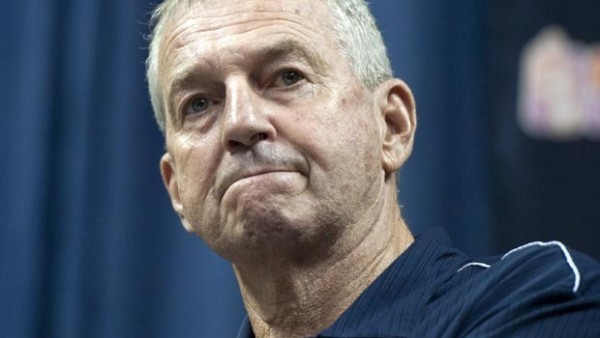
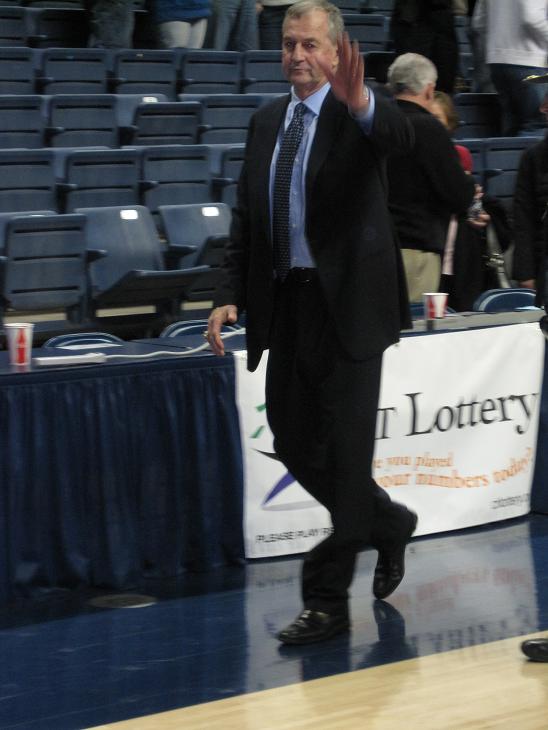
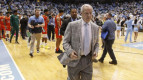
UConn’s basketball success is tied to Calhoun’s legacy (Photo credit: AP Photo/Jessica Hill).

With UConn ineligible for the postseason in 2013 and a depleted roster to work with, Ollie faces a tough road in the upcoming season. Whether or not he is the best choice to lead the Huskies out of the Calhoun glory days is an open question, but the national media has opined in droves over the fate of UConn’s program now that it has lost its foundational architect. Here’s a sampling of some of the best Calhoun retirement-related pieces I’ve come upon in the wake of yesterday’s official announcement, with a brief pull-quote summary of how each writer believes the Huskies will march on without Calhoun.

Read the rest of this entry »

Morning Five: 09.14.12 Edition

Posted by rtmsf on September 14th, 2012

  1. Jim Calhoun is no longer the head men’s basketball coach at Connecticut, and for most of us covering this sport, we really don’t know of a time when that wasn’t the case. Say what you like about him, but the 70-year old head coach is arguably the greatest program-builder of the modern era. Consider this factoid: When Calhoun took the helm at UConn in 1986, the program hadn’t won an NCAA Tournament game in a decade and only had achieved four victories in its history. Since then? Forty-eight NCAA victories, 10 Big East championships, and of course, those three national titles. Incredible. Let’s run down some of the best articles on the legacy of Calhoun: Seth Davis (“His pals joke that he’s not happy unless he’s miserable.”); Mike DeCourcy (“That is what Calhoun did better than anyone, ever: Coaching ‘em up.”); Dana O’Neil (“He was pointed without being vicious, upfront with his complaint, yet willing to concede that there were two sides to that particular story.”); Alexander Wolff (“Calhoun needed a cantilevered epaulet for the chip on his shoulder.”); Andy Katz (“He created a national power at a school that lacked tradition, facilities and a deep recruiting pool.”). There’s also this collection of some of his best quotes from The Connecticut Post.
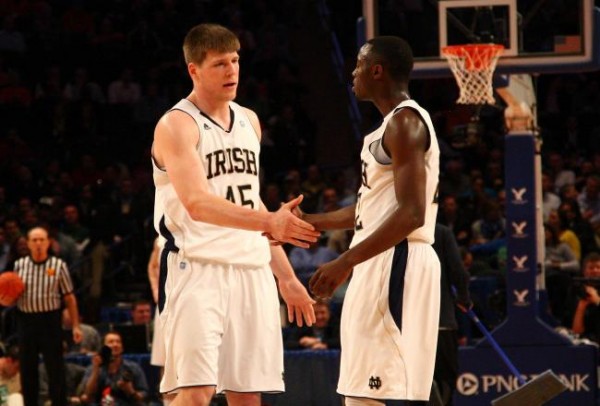
  2. Jim Calhoun helped make the Big East the basketball juggernaut that it became, but now upon the week of his retirement, he must feel rather bittersweet about yet another very good basketball program (Notre Dame) alighting for the greener pastures of the ACC. The media analysis is varied, but by and large, most people seem to think that this move was a win/win for both the school and the new conference. Head coach Mike Brey certainly must think so, given the reported quote to his AD regarding conference realignment: “Please don’t take me to the Big 12.” All chuckling aside, the ACC’s John Swofford can rest easy in the knowledge that he’s managed to protect both the league’s all-important basketball and academic branding while keeping the football schools in Florida and South Carolina equally engaged. If the ACC decides to grab another similarly situated basketball/Olympic sports school in the near future to get to 16, we proffered a few leading candidates on Thursday.
  3. We mentioned earlier this week the Raleigh News & Observer‘s report that Tyler Hansbrough‘s mother, Tami, had come under fire along with her boyfriend Matt Kupec (the Chief of UNC fundraising until this week) over a number of personal trips funded with university dollars where the couple traveled around the country to watch her other son, Ben Hansbrough, play basketball for Notre Dame. She was originally placed on administrative leave pending the outcome of the investigation, but late Wednesday Hansbrough tendered her resignation to the school, leaving little question as to her alleged culpability. The six trips to see the younger Hansbrough occurred during the 2010-11 season, but according to the N&O, the couple has taken as many as 25 trips together since May 2010 on the school’s dime. It’s unclear at this point whether any or all of those trips were legitimate, but this is yet another black stain on the UNC brand — it makes you wonder just what kind of internal controls they have in place in Chapel Hill, because it certainly doesn’t appear there are many.
  4. Sean Miller is absolutely tearing it up on the recruiting trail down in the desert, as five-star prospect in the Class of 2013, Rondae Jefferson, has committed to the Wildcats. A 6’7″, 215-lb. small forward from Chester, Pennsylvania, Jefferson’s commitment proves that the UA brand name remains relevant nationally, as Miller is on track to bring in his third straight top 10 recruiting class with this pickup. ESPN.com‘s Paul Biancardi describes Jefferson as one of the hardest-working players in his class, and is somewhat reminiscent of Kentucky’s Michael Kidd-Gilchrist in his relentless attacks on the rim. It’s been over a decade since another RJ patrolled the wing at the McKale Center, but without question Miller is looking to bring back those glory days with a continual influx of players like these. One other recruiting note: According to Rivals.com, eight of the top 10 players nationally in this class are still uncommitted.
  5. Let’s close with an uplifter in a week that was less than so… remember the tearjerker of a story involving a Gettysburg College player named Cory Weissman who had suffered a terrible stroke but who received a chance to play and made a single free throw — the only point of his college career — on Senior Day last season? The story got a lot of coverage last spring, with ESPN, SI, NPR, and just about everyone else doing a feature profile on his remarkable story. Well, that story had some legs, as 1,000 to 1: The Cory Weissman Story will begin shooting on the Gettysburg campus a little later this fall. If you don’t recall his triumphant moment, you can check it out on Youtube here — just make sure you have a few Kleenex handy.

Sizing Up Three Potential New Basketball-Centric Members for the ACC

Posted by Chris Johnson on September 13th, 2012

Chris Johnson is an RTC columnist. He can be reached @ChrisDJohnsonn.

If we’ve learned anything about the recent conference realignment craze, it’s that the two principles governing inter-league swapping – football, television rights deals and the thick crossover between them – have unintended and often detrimental consequences for the parties involved. Case in point: the Big East, unraveled at its foundational core by realignment forces, has seen itself morph from a tightly-knit group of basketball-oriented schools along the northeast corridor with legendary coaches and historic rivalries to a geographically disparate medley of culturally and academically incongruous programs, cobbled together in a last-ditch effort in the hopes of leveraging a lucrative media rights deal this fall. The deterioration has fueled the ACC – much like in the early 2000s, when it poached Miami, Virginia Tech and Boston College from the Big East – into becoming one of Division I college athletics’ premier power brokers, along with the SEC, Big Ten, Pac-12 and Big 12. More relevant to this space, the ACC, once all the moving pieces settle into their new league, is poised to field arguably the best compilation of hoops talent we’ve ever seen.

The ACC added a 15th basketball member in Notre Dame, but could No. 16 be on the way in the near future? (Photo credit: Mike Lawrie/Getty Images)

Commissioner John Swofford added another gem Wednesday in Notre Dame, who plans to join the ACC in all sports except football (the Irish will play five games annually against ACC gridiron competition, but maintain their independence). This addition brings the ACC to 15 teams, an unwieldy number that could have nightmarish scheduling implications. Swofford told ESPN.com that the league has no plans to add a 16th member, citing the disruption of football division equality, among other factors. Since the league isn’t divided into divisions for basketball, there is no immediate impetus to add another team, but it stands to reason that the ACC will eventually look to move to an even number of hoops teams, and what better place to address the problem than the beleaguered, battered, on-life-support (ok, maybe it’s not that bad) Big East? What follows is a brief analysis of a few potential candidates for that 16th spot, should it open up in the coming years, with an eye toward each team’s purported value from a hoops perspective.

*Unless Notre Dame decides to relinquish its football independence, it would seem unlikely that the ACC will take on another fully engaged football member so as to preserve its current seven-team divisional configuration. This analysis, therefore, is limited only to basketball-centric schools without major football programs.

Read the rest of this entry »

Morning Five: 09.13.12 Edition

Posted by nvr1983 on September 13th, 2012

  1. There were obviously two huge stories yesterday and we could lead with either one, but for us the imminent retirement of Jim Calhoun is the top story. Over the next few days you will see an endless stream of stories recounting Calhoun’s spectacular work turning a program that was essentially nothing into one of the top programs in the country. You will also see a number of anecdotes from media members about some of their memorable interactions with Calhoun. For now we will just focus on the near-term future for the Huskies, who will apparently name Kevin Ollie as their interim coach. Ollie certainly has his work cut out for him taking over a team that was expected to struggle next season even with a legend like Calhoun at the helm. We hope that the school grades Ollie on a curve here because otherwise his position will probably last only one season before the school looks elsewhere. If that does happen, it will certainly test the rankings we released last year for the most desirable coaching spots in the country. Will the brand appeal of Connecticut be enough to overcome the location and the current condition of the program for potential coaches?
  2. We are guessing that most sites will go with Notre Dame moving to the ACC in all sports except for football with the expected moved happening in 2014 at the earliest. While this is certainly another significant loss for the Big East it doesn’t come close to the significance of losing Pittsburgh and Syracuse especially since the real prize of Notre Dame’s athletic program is its football program, which isn’t exactly a revelation to anybody. The ACC was able to get Notre Dame to play a certain number of football games (five) against other schools within the conference, but Notre Dame was still able to keep its ludicrous lucrative contract and BCS privileges. Having said that, the Irish do bring a solid if unspectacular basketball program to the conference that will add more depth and strengthen its claim as the best in the country again [Ed Note: Many ACC fans would have you believe that they always were the best conference in the country.] For us, the more interesting facet of the story is that Notre Dame becomes the 15th basketball team in the conference, which as you may notice is an odd number. The ACC has insisted that there are no plans to expand to 16 teams, but it seems more than a little naive to think they won’t be looking out for another school to add to reach an even number. More on this later today.
  3. After a disappointing year in 2011-12 (and any Brad Stevens team that doesn’t make the Final Four is by definition, disappointing), Butler was looking to rebound with a strong 2012-13 season, but those hopes were dealt a significant blow when the school announced that Chrishawn Hopkins had been dismissed from the basketball team. Hopkins was one of four returning starters on a team that is also adding Arkansas sharpshooter Rotnei Clarke and was expected to be a tough out in next year’s NCAA Tournament. Fortunately for the Bulldogs they have some depth on the perimeter, but anytime you lead the #3 scorer from the previous year it has to hurt at some level. We are still not aware of which team rule Hopkins broke, but the fall term at Butler just started on August 22 so whatever he did was probably not related to grades.
  4. Another player who will not be seen on campus any time soon is Maurice Jones, who announced yesterday that he was transferring from USC after having been ruled academically ineligible. Jones, who was supposed to be the leading returning scorer for the Trojans, will certainly draw some interest despite his 5’7″ frame, but it will most likely be in the form of mid-majors where a smaller guard could be even more successful. Assuming Jones is able to get his academics in order he could be an excellent addition for a top mid-major and can give his new school two more years of eligibility. A potential destination somewhere in Michigan would not be out of the question given that is where Jones hails from, but with his skill set he should be able to look broadly.
  5. While the NCAA continues to fall behind on investigations into the wrongdoing of schools and their administrators it continues to excel at chasing after teenagers with questions regarding their eligibility. Two highly touted incoming freshmen — Sam Cassell, Jr., and Myles Davis — have been ruled ineligible by the NCAA as the result of classes they took at Notre Dame Prep, the same school that produced Michael Beasley, Lazar Hayward, and Ryan Gomes, among others. As Jeff Goodman points out, there are eight other individuals currently cleared by the NCAA to play who took those same classes. The entire situation appears to revolve around classes they took last academic year that at least Davis’ family claims were cleared by the NCAA until it was too late to change and maintain their eligibility. While this case will probably start out of the mainstream media for the most part it will be interesting to follow to see if the NCAA backs down or if the eligibility of the other students in those classes is questioned.

Jim Calhoun Expected To Retire

Posted by nvr1983 on September 12th, 2012

After years of speculation it appears that Connecticut‘s legendary head coach Jim Calhoun will finally retire. A local NBC affiliate in Connecticut was the first to report the news that Calhoun’s retirement was “imminent”. Calhoun, who turned 70 in May, has made a name for himself building up a Connecticut program that was not even on the map when he took over in 1986 to one of the premier programs in the country during his 26 seasons there. Calhoun’s credentials at Connecticut are nothing short of spectacular: three NCAA titles, seven Big East Tournaments titles, and nine Big East regular season titles to go along with several NBA stars. While Calhoun won big on the court he also went through his own trials and tribulations off it often battling the media (“not a dime back”) and dealing with a variety of medical issues. [Ed Note: For what it’s worth, in our limited interactions with Calhoun he always was courteous with us.]

Calhoun Appears To Finally Be Saying Goodbye

With the upcoming season essentially being a lost one for a program of Connecticut’s caliber (banned from the NCAA Tournament due to their low APR score) speculation was rampant that Calhoun would call it a career, but he remained committed (or indecisive depending on your point of view) to the program. However, his latest setback, a fall off his bike leading to a prolonged rehabilitation program, may have finally led Calhoun to step down. Now the next question is who will replace Calhoun. The most obvious choice would be Kevin Ollie at least on an interim basis although George Blaney is the one who has always served as the fill-in for Calhoun during his multiple absences over the years. Whether Ollie is able to shed the interim label will likely depend on the performance of this year Connecticut team. If they fail to live up to even the admittedly lowered expectations we could have one of the more interesting coaching searches in years to fill a spot at a marquee program that had essentially been created by the man leaving it.

Harvard Cheating Scandal Speaks to the Tenuous Relationship Between Academics and College Athletics

Posted by Chris Johnson on September 12th, 2012

Chris Johnson is an RTC columnist. He can be reached @ChrisDJohnsonn.

When word leaked nearly two weeks ago of a massive academic scandal at Harvard University, it was easy to overreact at the prospect of some of the nation’s brightest and most academically qualified students setting aside baseline expectations of academic honesty and integrity. After all, this is Harvard, long held as the putative gold standard of collegiate institutions, the dream school for practically every high school nerd with Ivy League aspirations. But when you dug into the details, which the New York Times provided one day after the allegations surfaced, none of it seemed particularly groundbreaking. Students enrolled in a 2012 spring Introduction to Congress class, which according to students had a reputation as one of the easiest classes at the school, colluded on take-home tests, questioned the fairness of graduate teaching assistants across sections and appealed to those assistants after reaching a consensus on unfamiliar exam terminology. There was a general understanding among enrollees that their actions were much less intentional than a product of a flawed conception of the school’s academic policies. All of which, at least as far as I could tell, undermined the severity of the transgressions. The only mildly surprising aspect of the story was the sheer number (125) of students implicated. It was a minor stain on Harvard’s sterling academic reputation, sure, but it certainly looked as if it would all dissipate in time.

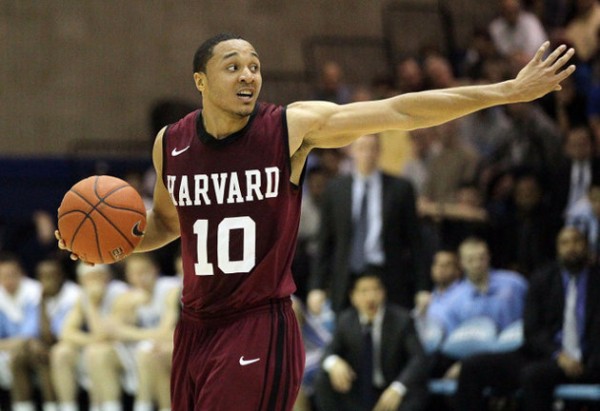
The defining storyline of the 2012-13 for the Crimson will be the academic scandal that enveloped Curry and Casey (Photo credit: Getty Images).

The ongoing investigation has now crossed into the athletic realm, per Luke Winn of SI.Com, who reported early Tuesday morning that co-captains Kyle Casey and Brandyn Curry, two cornerstones of the Crimson’s 2012-13 Ivy League title defense efforts, are in jeopardy of missing their senior seasons. Casey decided to withdraw before Tuesday’s fall enrollment deadline. While he is yet to receive punishment for his alleged involvement in the widespread academic fraud, Casey ran the risk of losing his final year of eligibility by attending classes this fall if school administrators render an unfavorable verdict. Curry hasn’t made a final decision as of this writing, but is expected to follow Casey and forgo the upcoming academic year. In surrendering their eligibility this season, both players are expected to return for the 2013-14 season. A third men’s basketball player, along with a score of football players, could also face renounced or curtailed academic schedules this year.

Read the rest of this entry »

Morning Five: 09.12.12 Edition

Posted by rtmsf on September 12th, 2012

  1. Another day, another scandal involving the, ahem, good name of college basketball. With all the allegations getting tossed around the sport in recent months, we’re starting to wonder if the best course of action is simply to burn the whole thing down and start completely over. After Tuesday’s disappointing news that even the nation’s top academic institution, Harvard, isn’t immune from student-athletes behaving badly, you’ll forgive us if we’re feeling a little more than down about our game. The skinny: SI.com’s Luke Winn has reported that senior co-captains Kyle Casey and Brandyn Curry — two of the Crimson’s best three players — have been implicated in a cheating scandal along with over a 100 other students for acts in a class about Congress “ranging from inappropriate collaboration to outright plagiarism, on a take-home final exam.” With the fall semester enrollment deadline pending this week, Casey and Curry are expected to withdraw from school for the entire 2012-13 academic year in an effort to preserve their final year of eligibility after their cases have been adjudicated. And with those withdrawals goes much of the hope surrounding the Crimson basketball program next season — the Crimson had more than enough talent and experience to win the Ivy League again and make the NCAA Tournament in back-to-back years. More to come on this later today…
  2. How’s about some better news to focus on with your coffee this Wednesday morning? Mike DeCourcy has us covered with his column discussing six important factors that could shape the upcoming season. Most of his points revolve around the significant loss of elite talent from last season, but keep in mind that going into 2011-12 many people thought that the return of the likes of Harrison Barnes, Jared Sullinger and Perry Jones would dominate discussion throughout the year. Although each player’s team made it to at least the Elite Eight, such a notion turned out to not be true. The talk last year mostly revolved around Kentucky’s precocious freshmen, Syracuse’s deep and athletic juggernaut, the resurgence of Indiana, and both Bill Self and Frank Haith’s coaching mastery. DeCourcy’s comment that “we’ll find something to enjoy” is absolutely spot on — predicting what that will be is the hard part.
  3. The NIT Season Tip-Off is one of the few remaining marquee preseason events that actually handles itself like a basketball tournament should, in that, it actually holds a tournament where winners advance and losers go home. And this is why it remains one of our favorites. The NCAA, who runs the event, announced yesterday that the top four seeds in this year’s Thanksgiving week event will be Michigan, Kansas State, Virginia, and Pittsburgh. Although John Beilein’s Wolverines will be the clear favorite in this event, there’s always some room for potential upsets — in a cursory review of the bracket, one intriguing subplot might be CJ McCollum’s Lehigh squad disposing of a revamped Pittsburgh team before heading to NYC to once again grab the national stage.
  4. It wouldn’t be a Morning Five this month without some mention of Billy Gillispie, so here’s the latest on the wild saga involving the Texas Tech head coach. On Tuesday two new pieces of information were released. First, an ambulance was called to Gillispie’s house on Monday of this week after a 911 call was made from the residence, but local hospitals had no record of Gillispie getting admitted anywhere. Next, in a text message sent to the AP Tuesday night, Gillispie himself stated that he plans on a treatment plan for high blood pressure “amongst other things” at the Mayo Clinic in Rochester, Minnesota. In the meantime as he deals with his health issues, Texas Tech has named associate head coach Chris Walker as the man in charge of the day-to-day operations of the team and told Gillispie in no uncertain terms that he is not to engage with the program in any way until he’s ready to sit down with the administration and discuss his future.
  5. If you’re a fan of the chaos theory of sports — that basically, the best possible scenario is the worst possible scenario — you’re going to love where the Lance Thomas case at Duke appears to be headed. According to the Raleigh News & Observer, not only is the New York City jeweler who extended Thomas nearly $70,000 in credit three years ago not talking to much of anyone, but in order for the NCAA to actually pursue what appears to be an obvious violation, they will have to do so by the end of 2013. So there are twin pressures building on the organization, but unless some degree of on-record information comes out through trial (highly unlikely), the NCAA will have to find a rat or some other documentation willing to assist them in this investigation. Chaos theorists loves this stuff, because it (mostly) leaves everyone outraged and upset.

Hosting Final Fours in Large Football Domes Makes the Most Sense

Posted by Chris Johnson on September 11th, 2012

Chris Johnson is an RTC columnist. He can be reached @ChrisDJohnsonn.

It always seemed slightly awkward that the Final Four, college basketball’s marquee postseason event, is played out in 70,000-seat football arenas across the country, rather than buildings actually designed to house basketball events. Fans spend the season watching their teams compete in basketball arenas across the country, many of which offer unique, quaint environments that are as much a part of the program as the team itself. In world where ticket revenue maximization and logistical considerations are the driving forces behind stadium construction and renovation, it’s these college hoops atmospheres – Hinkle Fieldhouse, Cameron Indoor Stadium, the Palestra – that give the sport a certain level of authenticity. There’s something endearing about the program-specific uniqueness that envelops college arenas, something vaguely intangible the sport simply wouldn’t be the same without. It would only make sense to have college basketball’s national champion determined under the same setting – not only for familiarity reasons, but to preserve college basketball’s amateur feel at the highest levels of competition. At the very least, basketball arenas – if not college structures, then NBA stadiums – offer settings far more tolerable than the large and unseemly football dome monoliths that have been adopted for college basketball’s three most important games (two national semifinals, and the championship game).

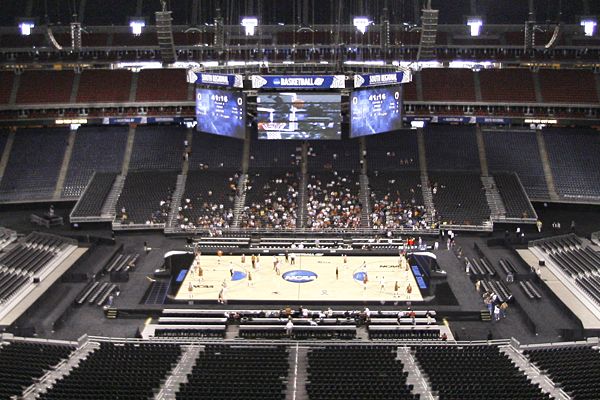
Large Domes like Ford Field have exclusively hosted the Final Four since 1997. That’s likely to continue for the foreseeable future (Photo credit: David J. Phillip/AP Photo).

But its no secret why the NCAA has opted for these awkward hosting sites. For one, bigger stadiums means more seats, which means more ticket revenues. If fans are willing to fill a reasonable proportion of a football dome’s enormous seating capacity in spite of several unattractive features – poor viewing angles, increased ticket prices – then it’s hard to argue with keeping the games in these large structures. From a revenue perspective, it just makes sense. But there are a host of other concerns to consider: space for increasing media contingents, infrastructural necessities (restaurants, hotels, parking, etc.), the conventions and parties and fan events that accompany major sporting events like the Final Four. Large football domes, despite all their aesthetic shortcomings, are better-equipped to handle the event in this regard. In short, football arenas in large cities offer the optimal blend of seating accommodations and resourceful necessities for hosting a sporting spectacle as massive and as important as the Final Four.

Read the rest of this entry »

Morning Five: 09.11.12 Edition

Posted by rtmsf on September 11th, 2012

  1. In the span of four days, Lance Thomas has become a much bigger name some two years after his graduation from Duke than the role player ever was during his time attending Duke. Everyone who follows college basketball in any capacity whatsoever has an opinion on how and why Thomas got himself embroiled in a jewelry purchase and loan during December 2009 that could ultimately cause the Blue Devils’ 2010 national championship to come under duress if he was in fact ineligible at the time. Here’s a smattering of written opinion on the matter from Monday: ESPN.com‘s Dana O’Neil does a good job framing the debate, but the jewel (ahem) in her piece openly refers to the dilemma that the NCAA faces in pursuing information and potential sanctions against one of its sacred cows. Bylaw Blog‘s John Infante describes the leverage that the NCAA could have over Thomas in order to force him to talk to them (namely, that the jeweler is likely to give his side of the story, forcing Thomas to respond). Over at CBSSports.com, Matt Norlander examines the Thomas case through the prism of troubles surrounding each of the four major programs on Tobacco Road, but the most compelling point in his story is that Thomas at Duke was apparently known as someone not at all prone to flash. Yet… we know that he purchased nearly $100,000 worth of jewelry. So many questions…
  2. Meanwhile, the hits keep coming at UNC. A report from the Raleigh News & Observer on Monday evening disclosed that former Tar Heel quarterback Matt Kupec, who had returned to the school to become its chief fundraiser, tendered his resignation when presented with evidence that he and Tami Hansbrough (the 2008 NPOY Tyler’s divorced mother, also a UNC fundraiser) took personal trips together on the university’s dime. Hansbrough was placed on administrative leave from her job at the school, but given her already tenuous job history at the school and allegations from school chancellor Holden Thorp that some of these trips were to watch her other son, Ben Hansbrough, play at Notre Dame, we’re wondering just how many other surprises there are hiding out on the various servers and job descriptions tangentially related to football and basketball at this university? More to come, we’re sure — welcome to 2012, the year that integrity in college athletics came home to roost.
  3. The Billy Gillispie saga continues to churn along, with additional news on Monday reported by ESPN.com that the Red Raiders’ leading returning scorer, Jordan Tolbert, hasn’t heard from the head coach in two or three weeks and doesn’t want to play for him again. In addition to that, CBSSports.com reported on Monday that Gillispie was not actually on sick leave as many outlets had reported; he is instead using accrued sick time to recuperate and has allegedly told athletic director Kirby Holcutt that he is not well enough to meet. While this very space has all but declared Gillispie’s head coaching career in Lubbock to be over, our Big 12 microsite’s Danny Spewak makes a compelling argument that the media’s general rush to judgment without hearing his side of the story is journalism at its worst — and you know what, he’s right.
  4. Connecticut may not have a lot to play for next season, and depending on the mood of its head coach, they may be looking at a complete programmatic overhaul, but the returning backcourt of Shabazz Napier and Ryan Boatright will ultimately determine the Huskies’ ceiling. The Napier half of that equation underwent surgery late last week to repair a nagging stress fracture on his right foot that doctors felt was not healing quickly enough for the point guard to be ready for the season. The rising junior is UConn’s most talented returning player and a legitimate candidate for Big East postseason individual honors, so they absolutely will need his production next winter to avert a massive cliff dive in both record and status.
  5. Larry Brown is well into his first year as the head coach of the SMU Mustangs, but the sad truth is that the rebuilding process will take some time in light of the paucity of talent left at the Dallas school. With that in mind, perhaps Brown’s open tryout scheduled for September 18 at the Crum Basketball Center will yield a diamond or two in the rough. You never know when a future Hall of Famer like Chicago Bulls great (and Central Arkansas walk-on) might literally stroll through your door. For those of you looking to get some instruction by the only dual NBA/NCAA coaching champion, the deadline to enroll in classes at SMU has unfortunately already passed. Maybe next year.

Will Lance Thomas’ Jewelery Purchases Endanger Duke’s 2010 National Championship?

Posted by Chris Johnson on September 10th, 2012

Chris Johnson is an RTC columnist. He can be reached @ChrisDJohnsonn.

The following names are listed as “clients” on the website of Rafaello & Co. Jewelers: Drake, Jay-Z, T-Pain, Lil Wayne, Rihanna, Justin Bieber. I’m barely scratching the surface of the illustrious canon of entertainment superstars and hip-hop moguls associated with the famous New York jeweler, but you get the point. This is not your average knock-off thrift shop. You don’t walk into Rafaello & Co. unless you have some serious cash to splash. So it’s not at all surprising that Lance Thomas, a starting forward on Duke’s 2010 National Championship team and a current member of the New Orleans Hornets, needed nearly $100,000 to purchase a black diamond necklace, a diamond-encrusted watch, a pair of diamond-stud earrings, a diamond cross and a black diamond pendant in the shape of Jesus’ head. No, what’s surprising is how Thomas was able to pony up $30,000 just two days after Duke defeated then-No. 15 Gonzaga at Madison Square Garden, in the midst of the Blue Devils’ title-winning season. And how Thomas was extended a nearly $70,000 loan to complete the glamorous spending spree. Even more puzzling is the fact that Thomas was expected to repay the loan within 15 days, and that Rafaello & Co. waited over two years to file a suit against him demanding he break even on the very credit he sought when he made purchase.

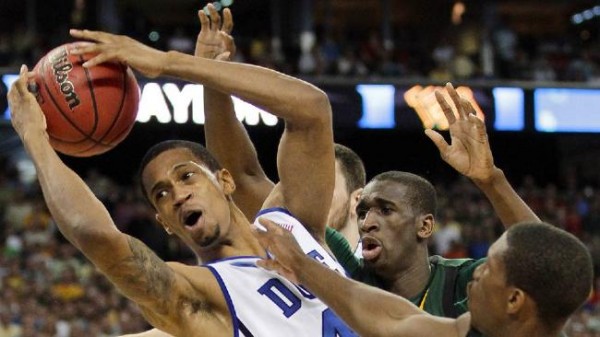
The NCAA will likely investigate Thomas’ involvement in a potential improper benefits scandal, endangering Duke’s 2010 National Championship (Photo credit: AP Photo).

There’s plenty to be resolved here, and it’s far too early to draw conclusions. But unless Thomas somehow managed to accumulate $30,000 (and was expected to raise nearly $70,000 on top of that within the next 15 days) while undergoing one of the more rigorous academic curricula in the nation and, mind you, the added time spent practicing, lifting, studying film and playing basketball at Duke, this situation has the looks of a hanging curve ball, slowly arching its way into the heart of the strike zone, awaiting its bludgeoning from the NCAA’s sanction-laced Louisville Slugger. If college athletics’ ruling body is determined to achieve one mission with its quirky and vaguely byzantine rulebook, it is to sustain the notion of amateurism. Student-athletes are not to use their extra-curricular activities as leverage to obtain financial benefits or other gifts unavailable to non-athletes. Which means Thomas must have received no outside assistance in making a five-figure lump-sum payment at a world-renowned jeweler. He had to have made the money himself. Nor could he have used his status as “Duke forward” to persuade the jeweler into giving him the loan. That’s the baseline assumption we’re making for his innocence. However, if an outside source provided aid when Thomas completed his transaction nearly three years ago, things could get ugly for one of college basketball’s marquee programs and the patron saint that bosses its sidelines.

Read the rest of this entry »