Morning Five: 06.17.13 Edition

Posted by nvr1983 on June 17th, 2013

morning5

  1. We are not sure what to make of Jerome Seagers and his decision to transfer from Rutgers to Auburn then back to Rutgers in less than two months in the wake of the Mike Rice scandal and claims that he left Auburn because he wanted to be closer to his family in Maryland while recovering from his time at Rutgers. Basically the entire thing does not make any sense, which is how we often feel about many of these transfers. As you would expect Seagers will be eligible to play next season for Rutgers since he never played for Auburn although with the way the NCAA enforces rules we would not have been shocked if they made him sit out a year for his indecisiveness.
  2. With Ricky Ledo having sat out last season we had almost forgotten about him, but it appears that NBA scouts have not as the Providence freshman is getting plenty of workouts from NBA teams. Ledo, who was a partial qualifier, worked out with the Providence team last season and according to Providence coach Ed Cooley often played the role of the best player on the opposing team thanks to his skill set, which was certainly well above any of the Providence non-starters. We don’t think that Ledo’s presence last season would have made them a NCAA Tournament team last season, but if he performs well in the NBA you can be sure that more than a few Providence fans will be asking themselves what might have been if he had been able to wear a Friar uniform.
  3. We are never sure what to make of how college players perform at the international level or even in tryouts. Many times they can be an indication of a player making a leap to another level, but there have been many cases where players do not carry over that solid play to their college teams. The same can be said of poor performances. Still the decision by the USA U-19 National Team to cut Rodney Purvis and Shaq Goodwin from the team that they made last summer is an interesting one. As Mike DeCourcy notes both omissions were surprising given the way that Purvis performed in workouts and the lack of interior depth the team had that should have assured Goodwin a spot on the roster. While the team lacks a big college star outside of Marcus Smart it does contain an intriguing mix of players who would seem poised to become stars on their teams next season.
  4. The recruitment of Michael Chandler will be interesting because it was just two years ago that he was a top-50 recruit and a top-five center in the class of 2011. Of course, that was before he was declared academically ineligible and had to go to junior college ending up at Northwest Florida State where he averaged 4.6 points and 2.4 rebounds per game. Even though some players particularly centers take a while to develop those are pretty uninspiring numbers from a player at that level trying to play Division I basketball. Still it appears Chandler has plenty of suitors including Purdue. Given Chandler’s output at the junior college level we would be surprised if he ended up being much more than a marginal contributor at the high-major level.
  5. On the other end of the spectrum we have Kadeem Allen, a first-team JUCO All-American, who has drawn interest from Arizona, Kansas, and Oklahoma State. Last week, Arizona formally extended Allen a scholarship offer. We don’t pretend to follow the JUCO scene that closely (our comments on Chandler were reflective of his low production not his actual game), but the people we follow who know the JUCO scene seem to believe that he is a high-major player and his first-team status suggests that is at least a reasonable possibility. Allen will spend another year at the JUCO level before heading to Division I, but he could be an interesting addition to whatever team he winds up playing for.

Florida’s Not Having The Best Offseason: Why Gators Fans Should Pump The Brakes and Just Chill

Posted by Chris Johnson on June 14th, 2013

Chris Johnson is an RTC Columnist. He can be reached @ChrisDJohnsonn.

One top-10 recruit’s eligibility issues on one national championship-capable roster typically wouldn’t feel like anything to work up a sweat over five months away from the start of the season. Chris Walker is one of the top players in the class of 2013. His addition arguably makes the Gators the most wholly-talented group Billy Donovan has coached since the 2006-07 national championship starting five. Florida would be better with him than without him. These things are all true, and they are all real. But academic eligibility issues like Walker’s – he still needs to complete three core courses and improve his ACT score before becoming eligible – usually (re: usually) tend to untangle themselves before the start of the season. It’s not like Walker attended high school classes that didn’t actually exist. And besides, what’s the worst that could happen? Walker is ruled ineligible for the non-conference season, only to enter Florida’s lineup around New Year’s for a repeat mashing of SEC competition? When you really bore down into what the Gators bring back, and who they welcome for the very first time, Walker’s possible ineligibility is less than crippling specter. More like a minor buzzkill in an otherwise tantalizingly positive summer season lead-up.

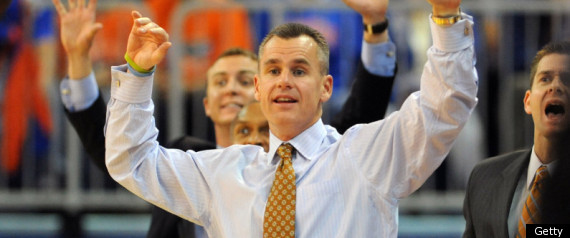
Unless Walker's academics keep him out for a large number of games, Florida fans best be relaxing, instead counting all the positives the Gators have going for them right now (Getty).

Unless Walker’s academics keep him out for a large number of games, Florida fans best be relaxing, instead counting all the positives the Gators have going for them right now (Getty).

Viewed on its own merits, Walker’s situation is an annoyance. A tic slowly sucking the preseason optimism out of Florida fans. Nothing more and nothing less. This particular situation is different, because Walker’s ineligibility isn’t the only thing the Gators are anxiously tracking this offseason. There are other concerns, and when you add everything up and lop Walker’s prospective ineligibility on top, what once looked like one of the four or five best teams in the country in the rushed postseason Top 25 deluge has a fistful of questions to get past before season opening in November. Senior point guard Scottie Wilbekin has been suspended indefinitely by coach Billy Donovan for an unspecified violation of team rules one year after a similar punishment forced him to miss the first three games last season. We can only presume another brief multi-game absence, or some form of serious punishment, is in the offing. There’s also senior forward Patric Young, who underwent a procedure in April on his ankle, and whose game – frustratingly unrefined and only incrementally improved offensively – hinges heavily on his sheer athletic capability. Forward Will Yeguete likewise had his right knee scoped out one month later, the second such arthroscopic procedure in a four-month span.

Read the rest of this entry »

Morning Five: 06.13.13 Edition

Posted by rtmsf on June 13th, 2013

morning5

  1. Another day, another mob with pitchforks standing outside the gates. ESPN.com‘s Darren Rovell reported yesterday that a group of former NCAA athletes has filed a $5 million suit in federal court against a company that sells photographs of college athletes without their express permission. Although the claim does not list the NCAA nor some 90 schools alleged to sell images to the defendant company, it wouldn’t be much of a leap to eventually go after them as well down the line. Under current NCAA rules, the schools have the right to promote their own games using player images, but the legal question will center around whether they also have the right to sell or transfer those images. This lawsuit is of course unrelated to the Ed O’Bannon likeness case also working its way through the system in federal court, but the underlying issue — that players are not compensated for their work and corresponding brand — is very similar.
  2. While on the subject of the mission of the NCAA and its member institutions, the Chronicle of Higher Education published a piece yesterday from a professor at Ohio State University named Steven Conn. Conn, an American history scholar, took his soon-to-be-former boss, OSU president Gordon Gee, to task not so much for his forced retirement based on a series of verbal gaffes; rather, for helping to create and propagate the “athletic-industrial beast that defines higher education now.” The point he’s ultimately making is that college presidents nowadays have to spend so much time dealing with their athletic programs because of the money and prestige associated with them, that they’ve completely lost sight of what the true mission of an institution of higher learning is supposed to represent. Interesting read.
  3. With all the pressure on programs to succeed in the revenue sports, it probably shouldn’t surprise anyone that the average D-I men’s basketball coach has been at his current job for a total of 38 months — just over three years. This information and plenty of other coaching longevity tidbits comes courtesy of D1scourse, Patrick Stevens’ site examining college sports in the mid-Atlantic area. Although it was news to us that only one coach has survived at one school since the ’70s (Jim Boeheim at Syracuse, 1976), and only seven since the ’80s, the real takeaway from his analysis is that over 55 percent of true seniors who signed a letter of intent in November 2009 have experienced a coaching change in their careers. And yet we continue to penalize them for transferring, why, again?
  4. While on that topic, a really odd situation has developed involving DePaul forward Donnovan Kirk, a player who spent the first two years of his career at Miami (FL) before transferring to Chicago for the last two seasons. Given Miami’s success under Jim Larranaga especially relative to the train wreck at DePaul, Kirk has now decided to use his graduate transfer exception to head back to Miami for his final season. That’s right: a double-transfer where he is ending up at the same school where he originally started. He only averaged 6/4 last season for the Blue Demons, but he’s a great leaper and was among the Big East leaders in blocked shots per game (1.6 BPG). He’ll move right into a lineup in Coral Gables that is extremely lacking in experienced size, so this appears to be a win/win for both parties.
  5. The fortunes next season for another major basketball school in Florida — not FGCU, sorry — are still somewhat up in the air at this early summer point of the offseason. There are always a number of players finishing up coursework and dealing with standardized test scores to become eligible for next season, but in the case of Florida’s Chris Walker, there are serious concerns about his eventual eligibility. Not only does he still need to pass the ACT, which he has now taken three times, but he has to finish three core course requirements over the summer before he can enroll at the university in Gainesville. With most players these days getting themselves on campus for the early summer term to start prepping for next season, it doesn’t appear that will be an option for Walker very soon, if ever.

Morning Five: 06.12.13 Edition

Posted by nvr1983 on June 12th, 2013

morning5

  1. As you probably already noticed yesterday was APR Day, the day that college administrators dread and one that spawns countless columns about inequities in the system. There were no major surprises in terms of which teams were ineligible and the biggest news of the day was probably the fact that Connecticut is eligible for the NCAA Tournament again despite having a four-year APR below 930 as they showed enough improvement that they were still able to qualify. The more interesting aspect of APR Day is that it led to several interesting articles such as those by Andy Glockner and Myron Medcalf that speak to issues beyond just educating/graduating athletes and are reflective of education in this country.
  2. The decisions on where conferences decide to play their conference tournament games has never been of particular interest to us since they are typically played at a neutral site and are based on purely financial reasons. Having said that the decision by the American Athletic Conference to play its first conference tournament in Memphis is an interesting one as it will essentially give Memphis a homecourt advantage with an automatic NCAA Tournament bid on the line. Typically conferences of the expected power of the AAC avoid playing at a non-neutral location for a variety of reasons including the benefit given to a team that is playing at home. It will be interesting to see where the conference decides to put its postseason tournament going forward if schools feel that Memphis is granted an unfair advantage.
  3. Yesterday we linked to an article about increasingly onerous transfer restrictions on players. We did not mention it specifically in our post, but as the article we linked to mentions players are able to get around this by opting not to tak e a scholarship at their new school. It happens infrequently, but in the case of a player like Kevin Olekaibe sometimes the circumstances are severe enough that the player is willing to pay his own way. In Olekaibe’s case the rising senior announced that he was transferring from Fresno State to UNLV even though he was not allowed to transfer within the Mountain West Conference if he accepted a scholarship. Olekaibe’s reason for transferring and hoping for a transfer waiver that would allow him to play right away is that he wants to be closer to his father who is paralyzed from the waist down and is unable to speak because of two strokes that he has had. The way that transfer waivers have been granted lately we would be surprised if the NCAA turned his request down.
  4. In the wake of San Antonio’s win over Miami last night, Seth Wickersham’s article on the Spurs success being a condemnation on the state of grassroots basketball in America will probably become a bigger talking point. While we can agree that American basketball has many issues to improve on (the outsized influence of certain individuals at the AAU level being one of the most prominent) it is worth noting that the US continues to be far and away the most prolific country in the world in terms of producing basketball talent and that goes beyond just the national teams we send out every year. The gap between the depth of our talent and that of other countries is probably more significant than you might appreciate from watching international competition. Another key point that the article conveniently glosses over is that Spurs star Tim Duncan is actually a product of the American basketball system that the article criticizes as he played four years of college.
  5. We are not sure if the Bernie Fine case will ever end. The former Syracuse assistant coach’s defamation lawsuit against ESPN is heading to federal court now and it appears that Fine and his lawyers are targeting the corporation at this time and no longer pursuing charges against the reporters involved in reporting the story. As anybody who has followed the case over the past two years knows the entire case has been extremely messy and Fine’s accusers have been questionable at best in terms of the reliability and consistency of their statements. At this point we imagine that Syracuse views this case the same way that many media members do in that we just wish it would end.

Morning Five: 06.11.13 Edition

Posted by nvr1983 on June 11th, 2013

morning5

  1. Coming into this season Scottie Wilbekin‘s starting job was in peril with the arrival of talented freshman Kasey Hill at Florida, but you might have reasonably expected that the rising senior could bank on his experience and maturity to give him an edge in playing time. That is until Wilbekin was suspended indefinitely for an unspecified violation of team rules. This is not the first time that Wilbekin has been suspended indefinitely in the off-season as he faced a similar suspension last year and ended up missing the first three games of last season. We have no idea what Wilbekin was suspended for and if it is related to his suspension last year, but it places Billy Donovan in a difficult situation on both what to do with Wilbekin as well as how to ease Hill into the starting point guard job as we would expect Wilbekin to miss at least a few games at the start of the season if the infraction was significant enough to warrant the team disclosing it in June.
  2. It should not come as too much of a surprise but Andrew Wiggins will not be playing for the Canadian national team this summer. Wiggins like many of his American contemporaries is passing on the opportunity to play for his country’s U19 team at the FIBA World Championships. Like them Wiggins will be trying to get an early start on his college experience and given how brief Wiggins’ stay is expected to be that makes sense. Of course we do not expect this will have any long-term repercussions for Wiggins in terms of being named to future Canadian national teams as he is essentially viewed as the future of the sport in the country.
  3. Even in the crazed world of college transfers the decision by Jerome Seagers to back out of his transfer to Auburn is a curious move. Seagers, who averaged 6.5 points and 2.6 assists per game last season, announced his transfer from Rutgers to Auburn in the wake of the Mike Rice scandal. Now a month later Seagers has decided that Auburn is not the ideal destination for him. We will probably never be sure of the reason why Seagers decided to back out of the transfer, but according to Auburn the stated reason is that  “he hadn’t truly recovered emotionally from his time at Rutgers.” Whatever the reason is for his decision it will be interesting to see where Seagers ends up, but from the school’s statement it would appear that he wants to be closer to his family in Silver Springs, Maryland.
  4. Speaking of transfers The New York Times took a look at increasingly onerous transfer restrictions with a focus on a couple of particularly notable cases. The article does not take a look at some notable cases in college basketball where player transfers were blocked although the ones we have seen do not block nearly as many universities (see Todd O’Brien) so we know the problem extends beyond just college football. The big question of what drives these type of tactics is one that the article cannot get to bottom of because coaches will never talk about it, but it is likely one of asserting their power over the athletes to try to prevent future transfers by making the transfer process as difficult as possible.
  5. There are a lot of crazy stories happening with conference realignment, but one that will probably be largely overlooked is how moving conferences will change the finances for schools even in areas that are not the school’s primary focus. Take the move of Kenya Hunter for example. Normally we would not highlight the move of an assistant particularly one who has not been rumored as a top candidate for significant head coaching positions, but Hunter’s lateral move from Georgetown to Nebraska speaks to the changing finances of the two schools. This is not to suggest that Georgetown is falling apart, but instead should highlight how TV contracts can alter how an athletic program is built because five years ago we could not even fathom someone leaving Georgetown for a similar position at Nebraska (frankly, we are still having trouble comprehending it).

UNC’s Athletic Scandal Is Far From Over

Posted by Chris Johnson on June 10th, 2013

Chris Johnson is an RTC Columnist. He can be reached @ChrisDJohnsonn

Job resignations don’t get more prescient than former UNC chancellor Holden Thorp’s decision last week to leave the school for the smaller and less hectic D-III pastures of Washington University in Saint Louis. Thorp’s stated reason for leaving – that the burden of making crucial decisions about a major college athletics program, lopped on top of his educational and administrative responsibilities, had worn Thorp thin over the past three years – is the perfect precursor for the recent news surrounding the Tar Heels’ athletic program. The academic scandal that surfaced last year to widespread dismay and doomsday-forecasting, then faded from the national spotlight, appears to have turned a resentfully bleak corner. A public records request from the Raleigh News & Observer issued last year, around the time of the initial reports of academic malfeasance within UNC’s athletic department, was granted just this month, and the findings only further validate Thorp’s clairvoyant departure. Emails between Tar Heels’ athletic-academic officials and Julius Nyang’oro – the former head of the former, erm, extinct African-American Studies department that allegedly greased the rails for scores of athletes (including football, and possibly men’s basketball, players) to stay eligible through fraudulent, or even non-existent, classes – turned up evidence of even greater systemic failures than we might have initially thought. The details aren’t pretty. This exchange between former football academic coordinator Cynthia Reynolds and Nyang’oro offers a window into the sort of deep institutional collusion UNC potentially left unmonitored within its athletic department.

What once looked like a swath of empty academic allegations could lead to heavy punishment (Getty).

What once looked like a swath of compelling but forgotten circumstantial evidence could lead to heavy punishment (Getty).

In one email from September 2009, Cynthia Reynolds, a former associate director who oversaw academic support for football players, told Nyang’oro in an email that “I hear you are doing me a big favor this semester and that I should be bringing you lots of gifts and cash???????”

When allegations of academic propriety were first brought to the fore, reaction was critical and uncompromising. All the signs of a collectively coordinated academic fraud were plain: shoddy transcripts, rinky-dink classes, a rogue department head with a dubious academic track record. Slowly but surely, the whole thing poofed into a cloud of oblivion. Nothing to see here, folks. We’ve got this under control. The media heat may have cooled, and powerful interweb columnists may have loosened their clench on UNC’s academic reputation, but the actual evidence never disappeared. Julius Peppers’ specious and internet-leaked transcript was still lying around on some investigator’s desk. The African-American Studies department’s comically easy jock classes did take place. Holden Thorp bolted the premises for a reason. The condemning evidence never went away, and now, after a year’s delay, when the dust had cleared and UNC athletics had emerged from the foreboding smog of NCAA sanctions and leaky academic oversight, the forgotten demons are reappearing.

Read the rest of this entry »

RTC NBA Draft Profiles: Jamaal Franklin

Posted by BHayes on June 10th, 2013

nbadraftprofiles

The NBA Draft is scheduled for Thursday, June 27, in Brooklyn. As we have done for the last several years, RTC will provide comprehensive breakdowns of 20 of the top collegians most likely to hear his name called by David Stern in the first round on draft night. We’ll generally work backwards and work our way up into the lottery as June progresses. As an added bonus, we’ll also bring you a scouting take fromNBADraft.net’s Aran Smith at the bottom of each player evaluation. This post was contributed by RTC’s Bennet Hayes. He can be found on Twitter @HoopsTraveler.

Player Name: Jamaal Franklin

School: San Diego State

Height/Weight: 6’5”/190 lbs.

NBA Position: Shooting Guard/Small Forward

Projected Draft Range: Mid to Late First Round
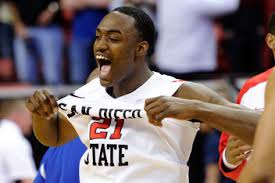
Jamaal Franklin is not one to lack in confidence, but will his manic, aggressive game translate to the NBA?
Jamaal Franklin is not one to lack in confidence, but will his manic, aggressive game translate to the NBA?

Overview: After highly productive sophomore and junior seasons, Jamaal Franklin decided the time was now to depart San Diego State for the NBA Draft. The explosive wing helped key the continued success of Steve Fisher’s program, as the Aztecs earned top eight seeds in the NCAA Tournament in each of Franklin’s three seasons there. There is little that is prototypical about Franklin’s game. He is a scoring wing who struggles to shoot the ball from deep (just 28% from three-point range last season) but rebounds the ball as productively as any big (his 26.4% defensive rebound rate was 10th nationally a year ago). Franklin’s unconventional game will undoubtedly undergo some tweaking at the next level, as whispers of an improved jump shot and the nature of the bigger, more athletic front lines in the league should have him spending more time on the perimeter. Adjustments will be needed to reach his potential, but if Franklin continues to display the hyper-competitiveness and endless motor that fueled his prodigious collegiate efforts, whichever team ends up using a selection on the 2012 MW POY should end up a happy buyer indeed.

Will Translate to the NBA: Pairing Franklin’s natural competitiveness with his athletic ability makes him an NBA-ready defender from the get-go. He also graded out very well in measurements at the combine (despite not participating in any activities due to an ankle injury), and although just 6’5”, his seven-foot wingspan should allow him to see time at both the two and the three in the NBA. And while you can rest assured that Franklin will not be rebounding at the clip we witnessed at San Diego State, that length, combined with his superb bounciness, will make him an above-average rebounder from the wing early in his NBA career.

Read the rest of this entry »

Morning Five: 06.10.13 Edition

Posted by rtmsf on June 10th, 2013

morning5

  1. The biggest news impacting college basketball over the weekend came from Tobacco Road, as the Raleigh News & Observer‘s Dan Kane has continued to push forward in his dogged pursuit of the truth involving to the North Carolina athletic department’s relationship with a decade-plus history of fraudulent courses involving many of its student-athletes. We plan on having more commentary available later today, but as Kane continues to show with his persistence, there doesn’t appear to be any question that the academic support people charged with assisting student-athletes in their coursework were entirely too cozy with the administrators — Julius Nyang’oro and Deborah Crowder — who were ultimately proven responsible for the no-show courses and other academically fraudulent activities. These recently released emails exhibit that Nyang’oro received perks and benefits that were ethically improper (i.e., sideline passes to UNC football games) given that athletes may have been steered to the bogus classes under his watch. This latest reveal gets Kane one step closer to a direct connection with the athletic department, as the academic support staff who appear to have been nudging athletes to these courses and providing Nyang’oro with perks are under the employ and direction of the athletic department. Are we to take at face value that these staff members were acting on their own in a rogue manner; or was there a wink-and-a-nudge agreement in existence here, from the top down? Credit to Kane to continue rattling the cage in Chapel Hill — apparently there are a number of possibly instructive emails that were not released because of student privacy and/or personnel concerns. We’ve said it before, but the University of North Carolina really needs to take more responsibility over this entire situation. 
  2. UNC, of course, has a ridiculously successful basketball program to protect, and keeping that brand viable and competitive is one of the cornerstones of the new ACC as it moves into a basketball environment that Mike Krzyzewski has already called the “best ever.” ESPN’s senior VP of college sports programming, Burke Magnus, did an interview with Al.com last last week, where he described college hoops programming as very important to ESPN’s continued success in the sports broadcasting marketplace, but also focused specifically on the new-and-improved Atlantic Coast Conference as the key to higher (even approaching college football) television ratings going forward. SI.com‘s Andy Glockner took the time to evaluate his statements — could ACC basketball become SEC football, in other words? — finding that Magnus’ hoped-for ratings may be a bit ambitious, but ESPN’s move of the ACC to Big Monday and the congregation of so many nationally-relevant programs in the same league will without question have a positive impact on viewer interest.
  3. Later today the sportscaster who probably had more influence than any other in making college basketball a name-brand, marquee American sport, will be inducted into the National Sportscasters and Sportswriters Association Hall of Fame. Dick Vitale, long before he was Dookie V. or some kind of embellished caricature of himself, was must-see viewing along with the teams of the 1980s and 1990s — if you listen to some of those broadcasts now on ESPN Classic, a keen observer will note that Vitale’s analysis was often spot on, making his more muted schtick considerably more appealing as an exciting conversational tool. At some point around the turn of the last decade when Vitale lost interest in providing thoughtful analysis and instead became synonymous with cheerleading for certain blue-blooded programs (ahem), many of the younger generation of fans turned on him and have rightfully viewed him as an anachronistic dinosaur ever since. Still, his influence on the sport as a whole is far beyond what any other national college hoops broadcaster has ever reached, and Vitale deserves all the accolades he is now receiving, in this, the twilight, of his long and illustrious career.
  4. There was some transfer news over the weekend, as former Indiana guard Maurice Creek announced that he will spend his graduate transfer year at George Washington, and Illinois forward Myke Henry announced that he will spend his final two seasons at DePaul. Both players are transferring back home, as Henry is a Chicago native and Creek grew up in the suburbs just outside Washington, DC. The new Colonial, Creek, represents a very intriguing situation — a one-time rising star whose career was sidetracked by multiple injuries, he could provide an immediate lift on the perimeter to a young team desperately in need of some senior leadership and scoring punch. Henry will have to sit out next season, but he will join a talented recruiting class in 2014-15 with a year of action under its belt that can probably use the versatility on the wing that Henry can provide.
  5. There was some very sad news over the weekend, as colorful longtime Miami (OH) head coach Charlie Coles passed away at the age of 71. As the Athens Messenger writes in a column about his life, Coles was “one of a kind,” the kind of old school coach who “always had a minute; always had a story.” He retired from basketball in 2012 after enduring years of health issues, but his teams at Miami were generally known as very tough outs — he took the Red Hawks to three NCAA Tournaments including a Sweet Sixteen in 1999, a couple of NITs and CBIs, and was regularly competitive in the even-steven environment of the MAC. Twitter reaction around the college hoops universe about Coles‘ passing was proper and respectful, but this video of his press conference after a close-but-no-cigar loss at Kentucky in the 2009-10 season is perhaps more revealing (and fun). You can leave his family a note on his Legacy page here; he certainly will be missed.

College Sports Needs To Rethink Its Leadership Structure

Posted by Chris Johnson on June 7th, 2013

Chris Johnson is an RTC Columnist. He can be reached @ChrisDJohnsonn

The relationship between the NCAA and the schools it governs has grown more tense and distrustful over president Mark Emmert’s tenure. This is a simple observation – anyone who watches, reads or writes about college sports can’t go more than a few weeks without catching wind of some new bureaucratic squabble. But without digging deep and realizing the systemic disconnect that defines the relationship between the NCAA and the people its rules actually affect, it is impossible to comprehend just how incompatible the organization has become with everything college athletics, and their place within the larger academic missions of their respective universities, should be. Outgoing North Carolina Chancellor Holden Thorp’s comments Thursday upon leaving his post at UNC and moving on to D-III Washington University in St. Louis get at the core of what has been the NCAA’s most glaring issue under Emmert (and even before that): Sports people aren’t making sports decisions. People in academia are.

Being a president at a high major university means getting involved with important matters better-reserved for more qualified athletic department officials. Thorp saw the need for a redistribution of power, and left his post to avoid further consternation (AP).

Being a president at a high major university means getting involved with important matters better-reserved for more qualified athletic department officials. Thorp saw the need for a redistribution of power, and resigned from his position to avoid further consternation (AP).

“Either we put the ADs back in charge and hold them accountable if things don’t work,” Thorp said in April during a campus forum, “… or let’s be honest and tell everyone when we select (presidents) to run institutions that run big-time sports that athletics is the most important part of their job.”

That sounds crazy, when you really think about it. Proposals to change inane bylaws and recruiting restrictions and scholarship limitations are being voted and ingrained into the NCAA’s rulebook by high-brow yes-men, the type of people who get up on stage at an athletic council meeting, get cozy behind a microphone and insolently mock everything from entire athletic conferences to religion stereotypes to individual coaches. College presidents, powerful leaders with academic backgrounds, are the ones taking the reins on the same issues athletic departments and coaches spend months and years wringing their hands about. If this presidential control model seems insanely ill-fitting, or just plain dumb, blame the Knight Commission on Intercollegiate Athletics, a group founded in the early 1990s to address the growing unease among educators of athletic departments’ lax enforcement of rule and regulations. Their solution – such as it was – was to hand control to the presidents and chancellors, esteemed educators with no specific experience dealing with the dizzying complexities of college athletics. The leaders of massive public universities would work with the NCAA to come up with reasoned solutions on how to address the problems athletic departments let linger far too long. ADs and other athletic department officials had it all wrong. Let’s hand this over to the presidents. They’re smart, right? They can handle this. They know exactly what they’re doing.

Read the rest of this entry »

Morning Five: 06.07.13 Edition

Posted by nvr1983 on June 7th, 2013

morning5

  1. After leading North Carolina in scoring last season many people expected PJ Hairston to build on a game that many considered worthy of a first round pick next year. If Hairston was planning on doing that, he is off to a very bad start as he was arrested on Wednesday night for driving without a licence and for possession of marijuana. We are guessing that not much will happen to Hairston other than a lecture from Roy Williams and possibly some early-season punishment.
  2. One of the things that critics of the NCAA have latched onto recently is the difficult financial situation that some former athletes are put in when they get injured playing and are forced to endure a lifetime of medical bills with little assistance from the entities that they were representing when they sustained those injuries. In response to that the NCAA is creating a $10 million catastrophic injury insurance pool. As anybody who has dealt with trying to collect on an insurance policy is aware this can be extremely complicated so we are hesitant to say too much about it, but we will be interested in seeing how this money is distributed in cases where many would deem it necessary.
  3. With Michael Dixon’s move to Memphis there will be quite a bit of talk about whether or not he should be allowed to play immediately as he essentially sat out one season. As Dana O’Neill points out the precedent set by the Dez Wells case suggests that Dixon should be able to play immediately. Perhaps more importantly it also sets a dangerous precedent for how transfer cases are handled when dealing with issues involving sexual assault. Having said that there are plenty of other things that the NCAA needs to fix with the transfer process although this one may strike a chord with a bigger audience given the political and social implications of these type of cases.
  4. If you did not get a chance to watch a college basketball game on a ship the past two years, you may be waiting a while to see the next one. After the initial success of the Carrier Classic between North Carolina and Michigan State in 2011 there was relative explosion of games on ships. Unfortunately, the games last season were affected by bad weather and it appears that there will be no games on ships this season. As we have stated in this space before these types of games/events are nice in select conditions, but they need to be saved for special events not just as a gimmick to be used frequently. As such it makes sense to put a hold on these games for now until somebody can come up with a sensible plan for if (and how) these games should be played in the future.
  5. It always bothers us when we see a former college basketball player get into legal trouble and former UNLV star Patrick Savoy is no exception. Savoy, who led the Rebels in scoring his senior season, was arrested Wednesday night after attempting to sell $300 worth of cocaine to an undercover detective. Savoy, who never played in the NBA, but played internationally until 2007, was released from jail yesterday morning. We have not heard anything about Savoy’s past records and are not aware of how tough the drug laws in Nevada are (we would assume not too stringent given our image of Las Vegas), but given how quickly he was released we would be surprised if he faced a substantial penalty.