Big East M5: 12.10.12 Edition

Posted by Will Tucker on December 10th, 2012

  1. After Georgetown edged Towson 46-40 on Saturday, the dust still settling from a tedious 37-36 decision over Tennessee the week prior, Daniel Martin at CollegeBasketballTalk says it’s time to start questioning the Hoyas. He points to streaky outside shooting in particular as the element that makes it most difficult to predict where John Thompson III’s team will end up in March. Against Towson, leading scorers Otto Porter, Markel Starks and Greg Whittington combined to shoot 2-14 (14%) from beyond the arc, and the Hoyas’ bench contributed but a single point. The team has racked up the most inefficient offense in the Big East, and it seems that an off night from Porter and Starks is all that separates the team that took Indiana to the wire from the one that couldn’t score 40 on Tennessee.
  2. Syracuse played this past Saturday as well, scoring more points than Georgetown and Towson combined as they stormed past Monmouth, 108-56. Sean Keeley at Troy Nunes Is An Absolute Magician points out that it was the team’s most prolific offensive display since hanging 125 on East Tennessee State in 2007. This team certainly looks more talented than that NIT squad, a point C.J. Fair, DaJuan Coleman and Michael Carter-Williams each asserted with double-doubles. Carter-Williams in particular tallied 16 assists –– the third most in Syracuse history –– and is unquestionably playing better than any point guard in the Big East right now.
  3. Ed Donohue at VU Hoops crunched some numbers and reached some frightening conclusions about Villanova’s penchant for second-half collapses in the past two seasons. Since the beginning of 2011-12, ‘Nova has suffered a negative second half scoring margin in 66% of its 41 games, and has gone on to lose 10 games in which they’ve led at halftime. It’s an ominous statistic that certainly doesn’t improve the outlook on Jay Wright’s job security.
  4. Louisville Courier-Journal columnist Tim Sullivan writes that Russ Smith is burdened by the reputation for volatile play he earned in his first two seasons. Despite having cultivated that style beyond anyone’s expectations to the point of becoming an elite college guard, it’s difficult to transcend the “Russdiculous” moniker bestowed affectionately upon him by Rick Pitino. “Any mistake I do –– one mistake –– keeps that perception,” said Smith. Before the season, it was hard to imagine Smith becoming more essential to Louisville than Peyton Siva or Gorgui Dieng. Even the most unorthodox dark-horse advocates would have scoffed at the notion that Smith might receive All-American hype in December. But that’s exactly what Sullivan suggested after Smith poured in a career-high 31 points, seven boards, five assists and five steals against Kyle Korver’s little brother and a hapless band of UMKC Kangaroos on Saturday. The junior two-guard is now second in the Big East with 20.3 PPG (on a surprisingly efficient 45.4% from the field), and fifth in the nation in steals.
  5. Speaking of Louisville, Rick Pitino broke with convention to answer a reporter’s phone and coordinate cocktail hour during his post-game press conference on Saturday. It was a bizarre moment that fortunately appeared on YouTube almost immediately. More importantly, it represents a levity that you wouldn’t expect to see very often from Pitino prior to this past March, as he seems to really be enjoying his job again after several years where nothing seemed fun for the volatile head coach.

Share this story

Morning Five: 12.10.12 Edition

Posted by nvr1983 on December 10th, 2012

  1. We figured that the NCAA’s decision to pull its championship events from New Jersey was the last we would hear of their issue with the state’s legalization of sports gambling. It looks like the NCAA (and the four major professional leagues) are just getting started. You may or may not remember that back in August those organizations sued the state for its legalization of sports gambling, which the state attempted to throw out. On Friday, the leagues/organizations filed a motion in an US District Court to stop New Jersey from dismissing the lawsuit. At the heart of the issue is New Jersey’s assertion that the Professional and Amateur Sports Protection Act of 1992, which restricted sports gambling to a handful of states, was unconstitutional. We haven’t dug too deep into the legal minutiae of the case, but it seems like New Jersey would have a pretty good case on the surface. Of course, they are going against a group of organizations who are all essentially federally enabled monopolies so maybe we are giving being too rational here.
  2. On the court the biggest news of the national happened out west where Mike Moser dislocated his right elbow during UNLV’s one-point win over California last night. At this point all we know is that he didn’t break any bones, but the extent of the injury is still not known and early reports indicate that Moser will be out for anywhere from a few weeks to the whole season. For a team that has struggled to find backcourt play to match the production and level of play of an absolutely loaded frontcourt could be a huge blow. We should have more information about Moser’s injury and how long he is expected to be out within the next couple of days.
  3. Moser’s injury is by far the most significant loss over the weekend (and possibly this season), a pair of players in the SEC will not be seeing the court any time soon as Mississippi kicked junior transfer Jason Carter off the team for violation of team rules while Louisiana State suspended Anthony Hickey indefinitely over a violation of athletic department and university policies. Carter, who never played a minute for Mississippi, was a transfer from Alabama via junior college and had been suspended before the team’s first exhibition game and never had that suspension lifted. We are not sure what Hickey, LSU’s starting point guard, did other than showing up late for tutoring sessions, but since the school’s fall semester ended recently we are guessing his suspension has something to with his grades.
  4. Utah State junior Danny Berger, who fainted during a practice last Tuesday requiring CPR and the use of a defibrillator, was released from the hospital and honored at the team’s game on Saturday. From what the school is saying the cause of Berger’s syncopal episode is still not known and he will need to be monitored for at least six more weeks before a decision will be made on if and when Berger can return to the court. Creighton guard Josh Jones, who had been hospitalized after fainting during warm-ups of the Bluejays game on Thursday, was out of the hospital and was on the bench watching the team’s victory over Akron yesterday. Jones has a history of fairly significant heart disease as he had his aortic valve replaced as a high school senior after developing a severe case of infective endocarditis–essentially a bacterial infection on his heart valve(s). The reason for Jones’ syncopal episode also is not known yet and he will undergo more tests this week before a decision can be made as to whether he can play again.
  5. Finally, Taylor University did its annual Silent Night event on Friday night. The event, which is done on the Friday night before finals week, was a cute, relatively unknown event where students attend the game, but are totally silent until team scores its tenth point of the game at which point the students make as much noise as they possibly can. The event has gained a great deal of notoriety in the past few years as more and more blogs feature it yet it still remains one of the more unique events in college basketball.
Share this story

Rushed Reactions: #22 UNLV 76, California 75

Posted by rtmsf on December 9th, 2012

Here are some quick thoughts from today’s California-UNLV match-up in Berkeley, won by the Runnin’ Rebels in the final seconds.

Three Key Takeaways.

  1. The National Debut of Anthony Bennett. A nationally-televised Sunday afternoon game allowed college basketball fans who may not have seen the freshman play before an opportunity to do so. They were not disappointed. Bennett showed a complete offensive game, going for a career-high 25/13 on 9-17 shooting and exhibiting an overall skill set that is reminiscent of a quicker-footed DeJuan Blair. Built at a legitimate 240 pounds if not quite standing 6’8″, Bennett has tremendous lift off the floor for a man his size and a very nice touch around the rim with his short jumpers and putbacks. His ball-fake leading to a baseline jam with a minute left was SportsCenter top 10-worthy, but we were equally impressed by his cool down the stretch in nailing two free throws to tie the game before that play, and a sweet pivot-and-shoot 12-footer to give his team a one-point lead heading into Cal’s final possession. Bennett is already playing like an All-American — get a look at him now, because it’s unlikely he’ll be around again next year.
  2. Offensive Rebounding Killed Cal. It was a problem for Cal all night long, and it ultimately did in the Golden Bears as Anthony Marshall’s airball with a couple of ticks remaining landed softly in the hands of Quintrell Thomas underneath, allowing him to calmly rise back up and drop in a layup to give UNLV the win. The Runnin’ Rebels finished the game with a monstrous 13 offensive boards, leading to numerous chances and an additional nine points. Mike Montgomery’s club has been a solid team on the glass this season, but the Rebels’ athleticism at every position seemed to surprise the Bears and helps to explain how a team that was shooting 65% at the half found itself behind by seven points (45-38) on its home floor.
  3. Mike Moser’s Dislocated Elbow. Only five minutes into the game, UNLV’s Mike Moser dove for a loose ball and remained on the floor in considerable pain. Later news reported that he dislocated his right elbow in the scrum and he could be out of the Rebels’ lineup for the next month. Dave Rice confirmed as much in his postgame interview and it was clear that he wasn’t sure how long this would hold Moser out for. The good news for UNLV is that Khem Birch is due to enter the lineup in a little over a week at the semester break, so even though he plays a different position, as Bennett put it, they’re similar in that they’re both “inside dominant players.” In a silver-lining sort of way, this could end up making Dave Rice’s team stronger in the long run, assuming Moser is able to get back to 100% by January.

Star of the Game. Anthony Bennett, UNLV. The precocious freshman with equally light feet to match his brawny frame not only went for a career-high 25 points and 13 rebounds in front of a hostile road crowd, but he also was responsible for a couple of clutch plays down the stretch — a ridiculously athletic baseline jam followed by a 12-footer from the opposite baseline — that allowed UNLV to stay close enough to win the game in the final minute. Here’s our interview with Bennett after the game:

Quotable.

  • UNLV head coach Dave Rice: “It’s not good. […] But I suspect we’ll be playing without him for some time,” referring to Mike Moser’s elbow injury.
  • California head coach Mike Montgomery: “Defensively, we got what we wanted. We got an airball as a matter of fact,” referring to the final defensive play that led to the game-winning layup for UNLV.

Sights and Sounds. There’s nothing in American sports quite like the cacophony of an entire arena joining in a chorus of boos. This incident was the result of Allen Crabbe’s questionable flagrant one foul in the first half, where he swung his elbow through to clear space and a UNLV player sold the contact convincingly.

What’s Next. Cal will have the week off before welcoming Creighton and Doug McDermott to Berkeley next Saturday night. UNLV has a throwaway home game against D-III La Verne on Thursday night before finishing off the first semester with UTEP at the Thomas & Mack Center. Incoming transfer Khem Birch is expected to be eligible after that point, especially important now that Moser’s status appears to be that he will not return to the floor for several weeks.

Share this story

Rushed Reactions: #14 Minnesota 71, USC 57

Posted by AMurawa on December 9th, 2012

Drew Murawa is an RTC correspondent. He filed this report from tonight’s Minnesota-USC game in Los Angeles.

Three Key Takeaways.

  1. 500 Wins. Tonight’s win was Tubby Smith’s 500th victory in his career and he becomes the 19th active head coach to reach that mark. Despite a national title, a National Coach of the Year award, and numerous other accomplishments under his belt, Smith gets overlooked regularly since he left Kentucky, but despite some offseason distractions, he looks like he has put together his best team at his current stop. After the game, he paused to reflect briefly and typically understated his accomplishment: “I have been in good situations and on programs who have been committed to basketball. Not everyone has that opportunity.”
  2. Golden Gophers For Real. Balanced scoring, superb athleticism up front, talented and savvy guards, depth and great coaching. Yup, that’s a pretty good recipe for a Top 25 team. Eight players saw seven minutes or more for Smith and seven of those guys scored at least six points. In the early moments of the game, it was clear that one of these teams was ready to go from the opening tip and one was not — Minnesota looked crisp, moving the ball around quickly and getting enough open looks to send USC looking for cover in a 2-3 zone. As it is now, Minnesota has a 10-1 record with wins over Memphis, Stanford, Florida State, and USC, and a loss to #1 Duke the only blemish. We knew teams like Indiana, Michigan, Michigan State and Ohio State were going to be a load, but coupled with Illinois’ big win at Gonzaga on Saturday, it looks like we can throw another pair on the Big Ten pile.
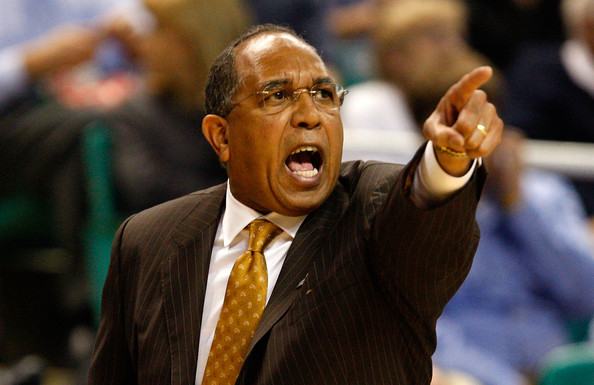
  3. Working Things Out. We’re a month into the season and Kevin O’Neill has no idea what he has here. His rotation seems to be little more than subbing guys in and out based on a whim. Eleven guys played in the first half, and while O’Neill tightened up his rotation to great effect in the second half, it just isn’t feasible to generate a brand new rotation every night out. Guys need to know their roles in order to give the coaching staff what they want. Start with the players you absolutely need to have on the floor (e.g., Byron Wesley, Jio Fontan, and Omar Oraby) and build an eight or nine-man rotation from there. There is enough talent here for the Trojans to make some noise in conference play, but O’Neill’s got to cobble together some type of coherent plan for that to happen. He certainly knows that, as he discussed after the game trimming his rotation based on effort.
Tubby Smith, Minnesota

Tubby Smith Earned His 500th Win Saturday Night With What Appears To Be His Best Minnesota Team

Star of the GameOmar Oraby. You hate to name a player on the losing team the star of the game, but in the second half at least, Oraby was the best player on the floor. He scored 15 points on 7-of-9 shooting, the Trojan offense ran smoothly through him in the post, he crashed the boards and challenged many shots at the rim, including a dunk attempt by Trevor Mbakwe on a breakaway that wound up with both players crashing to the floor. The whistle went against Oraby, but he maintained his innocence, even after the game. Oraby got 14 minutes in the second half and O’Neill sang his praises (except for his woeful free throw shooting) after the game, noting, “he’s gonna have to get a ton of time.”

Read the rest of this entry »

Share this story

Andrew Smith Shows His Importance to Butler’s Long-Term Fortune

Posted by Chris Johnson on December 9th, 2012

Chris Johnson is an RTC correspondent. He was in Evanston for Butler’s 74-65 victory over Northwestern at Welsh-Ryan Arena Saturday night. You can follow him @ChrisDJohnsonn

The biggest weak spot in Butler’s season body of work entering tonight’s game at Northwestern was a road defeat at Xavier. It was the Bulldogs’ second game of the season, and their only true road test. It was hard to know what to make of that result, mostly because Xavier itself remained something of a mystery. But over the next four weeks, as Butler notched impressive victories over Marquette and North Carolina at the Maui Invitational, and handled three consecutive home tune-ups against Hanover, Ball State and IUPUI, the perception lingered – however faint – that Butler needed to prove itself in a hostile road environment before drawing a long-term prospectus about the Bulldogs’ chances of competing in the new and improved Atlantic 10.

The Bulldogs dominated the paint against Northwestern, with Smith leading the charge en route to his best performance of the season (Photo credit: AP Photo).

Those doubts all but evaporated at Welsh-Ryan Arena Saturday night. Butler showed the poise, savvy and steadfast discipline that’s come to define Brad Stevens’ recent wave of national success. More importantly, it flashed newfound strength on the low block, a physical disadvantage that’s limited Butler in recent seasons against athletically superior teams. Senior center Andrew Smith had scored the ball at an efficient rate through the early part of the season, posting a 114.0 offensive rating and a 55.1% effective field goal percentage, but his usage rate (19.6 percent of available possessions) ranked behind two teammates and his main priorities typically hinged on defense and rebounding. Smith proved Saturday night he’s more than capable of carrying the load offensively. “I thought he played his best game of the year,” Butler coach Brad Stevens said following the Bulldogs’ 74-65 victory in at Welsh-Ryan Arena. “We needed every bit of it.”

Read the rest of this entry »

Share this story

Big Ten Microsite Roundup: Week of December 3

Posted by Deepak Jayanti on December 8th, 2012

In case you missed the Big Ten Microsite over the last few days or just want to catch up on some reading about the conference, check out the below links to some of our featured posts over the last week or so.  

Share this story

The Other 26: The RIP, Rick Majerus Edition

Posted by IRenko on December 8th, 2012

I. Renko is an RTC columnist. He will kick off each weekend during the season with his analysis of the 26 other non-power conferences. Follow him on Twitter @IRenkoHoops.

We start this week on a somber note, adding our voices to those who have mourned the passing of Rick Majerus. Much has been said, and said well, about his place in the game, as a teacher, a tactician, and a person. But his loss is felt especially deeply by fans of mid-major basketball. That’s in part, of course, because Majerus coached exclusively at non-BCS schools. He will go down with greats like Don Haskins and John Cheney as coaches whose imprint on the game far exceeded the imprint of the conferences in which their teams played. Most coaches who excel at the mid-major level quickly ascend to the top rungs of the game, a fact to which the annual coaching carousel testifies. Majerus never made the leap, his one opportunity prematurely aborted due to his ongoing health problems. As a result, he may never be mentioned in the same breath as Wooden, Knight, Smith, Krzyzewski, Rupp, or Allen, though he was perhaps their equal, if not better, when it came to Xs and Os.  But Majerus was able to do something that those greats were not — to make a distinctive mark on the game while operating from its periphery.
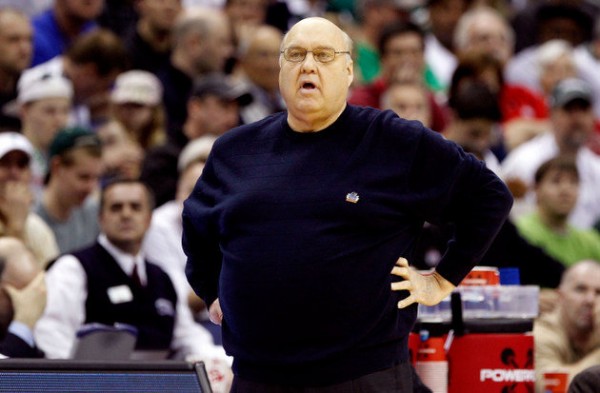
The Mid-Major Community Has Lost An Icon With The Passing Of Rick Majerus (Getty Images)

Yet, there was much more to what made Majerus a mid-major icon. It wasn’t just that he was coaching at the margins of the game, it’s that he seemed to be living at the margins of life. Has there ever been a more unlikely figure to pace the sideline at a National Championship game than the bald and portly Majerus, a divorced and childless bachelor living for years in a hotel and who, 30 years earlier, had been cut from his high school basketball team? We were all familiar with Majerus’ public battle with his appetite, which had exacted a personal and professional toll long before it took his life last week. Even the heartwarming stories of Majerus’ devotion to his mother seemed a constant reminder that this was a man who had formed no lasting human attachments beyond the one he came into the world with. He was a misfit and despite his disarming and self-deprecating personality, an easy target for ridicule.  But he proved that you don’t need All-American talent, All-American looks, or an All-American family to make good on an All-American promise — that one’s starting point does not dictate their destination. It is the maxim by which mid-major basketball abides, and for the past 30 years it has had no greater exemplar than the one we lost last week. May he rest in peace.

TO26 Top Ten

Read the rest of this entry »

Share this story

On Boeheim Scheduling: Do Tough November Games Pay Dividends in March?

Posted by Will Tucker on December 7th, 2012

Jim Boeheim’s Syracuse team has looked like the most complete in the country at points in its dominant 7-0 start this season. But tough road tests at Arkansas and against ranked San Diego State notwithstanding, their generally lackluster non-conference schedule (ranked #69 nationally thus far, according to StatSheet) exposes the Orange to the perennial “paper tiger” treatment their fans have come to expect. In his press conference after a shellacking of Long Beach State on Tuesday, Jim Boeheim argued unequivocally that scheduling difficult opponents in the first month of the season does not help a team prepare for the NCAA Tournament:

Jim Boeheim doesn’t see long term benefits in non-conference challenges, like playing SDSU in California

Boeheim makes the dubious suggestion that teams that suffer losses in November and December “aren’t even playing when it comes to the tournament.” That claim might raise eyebrows from slow starters like Brad Stevens, whose consecutive national runner-up squads each lost four games before New Year’s Eve. Boeheim stressed that his non-conference slate is designed exclusively to prepare for the Big East schedule, and that “if you’re not going to be ready in those 18 [Big East] games, then you have no chance to be good [in March].” While the league’s rigor is well documented, it can also present a liability when teams encounter unfamiliar styles in March: In each of the past two NCAA Tournaments, teams finishing in the top three of the Big East standings were all upset by lower seeds in the Elite Eight or prior.

Read the rest of this entry »

Share this story

Marching to Vegas: On Mark Lyons, And What Makes A Point Guard

Posted by AMurawa on December 7th, 2012

From the moment it was first rumored, the relocation of the conference tournament to Las Vegas has created quite a buzz among Pac-12 basketball fans. Adam Butler (@pachoopsAB) of PacHoops will be here every week as he offers his unique perspective along our March to Vegas.

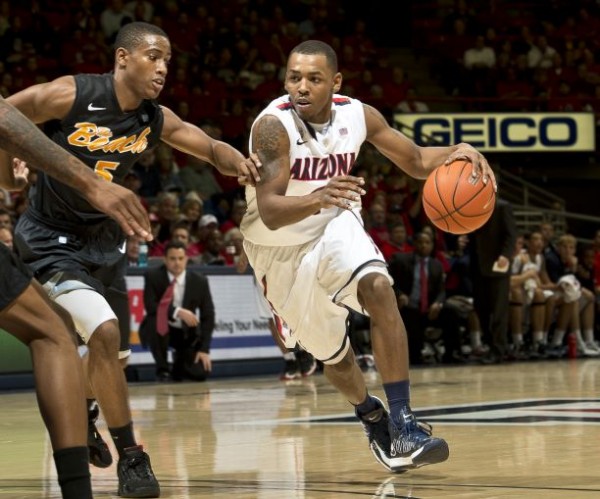
We knew Mark Lyons was going to be watched under a microscope the moment it was made public he’d transfer. There have been just a handful of grad transfers and he’s amongst the highest profile school swappers of that nature. All of this you know. What we did not know is whether Lyons would fit in with his teammates; whether bringing in a player of his caliber and hubris would be cancerous or auspicious; whether Mark Lyons could be a point guard? Much had been made of the third Lyons conundrum this week as the argument was made that the senior was struggling. Following his performance in Lubbock, he found himself with an underwhelming 0.8 A/T ratio. Not good. But knowing this fact, not once did it dawn on me that Lyons might be struggling, despite subsequently reading three different articles (third was an ESPN insider) regarding his struggles. I disagreed and proposed why he wasn’t struggling. Turnovers are a concern but that alone does not a point guard ruin.

Mark Lyons, Arizona

Mark Lyons’ Game Has Been Under Attack This Week, But While He May Not Be A Traditional Point Guard, He Helps His Team Win (Luke Adams)

Then this week’s Burning Question was proposed: Who is the best point guard in the Pac-12? So I sat down to begin my research, punched my password into KenPom and pulled up the Pac-12 cumulative stats; and then I realized I had no idea what I was looking for. Assist to turnover ratios? Assist rates? Turnover rates? Points scored or the lack thereof? It began grinding at me that I had no idea how to quantify a point guard. After all, we live in the era of Nate Silver so everything must be quantified. But as I burrowed further and further down the rabbit hole of advanced stats, looking into each of the conference’s point guards, I could find no continuity to the statistics. Dinwiddie led in ORtg and eFG%; Larry Drew II in assist rate; Ahmad Starks in turnover rate; Dominic Artis in steal percentage. Conversely, Dinwiddie and Starks don’t rack up many assists, Drew barely scores, and Artis does a little of a lot. And I hadn’t even begun to look at Justin Cobbs, Chasson Randle, Jahii Carson, Jio Fontan, or Lyons. Just on name recognition, I’m taking one of that second crew (I’d eventually pick Randle just because I really like his game). Alas, the BQ and my early week reading-and-rebutting had me stewing on Lyons and what makes a point guard. His oh-for-the-game, 4/2/2 and three turnover performance against Southern Miss on Tuesday then did nothing to help his cause. Or did it? Lyons played 29 minutes in that game and all of the critical ones. Statistically speaking, Mark Lyons struggled. But he continued to play, Sean Miller opting to keep the senior on the floor. It was in this tiny but all-important fact that I think I found my answer.

Read the rest of this entry »

Share this story

Pac-12 Pick’Em: Week Two

Posted by Connor Pelton on December 7th, 2012

Last Thursday, you may have remembered our Pac-12 Hoops Pick’Em that got underway in our M5. We’re back at it again this week, this time with a full post to go over the results from last week and to look ahead as well. Parker and I stole the show in week one, going a solid 11-2 to take a one-game advantage over Drew and Adam. I was the only one to miss Utah’s road win at Texas State on Friday night, but I came back to the field with Wyoming’s upset of Colorado. Parker and I took the lead thanks to San Diego State’s win over UCLA on Saturday at the Honda Center. So now, we enter week two. Colorado’s visit to Kansas and Illinois visiting Gonzaga headline the list as our games of the week.

Game Connor (11-2) Drew (10-3) Parker (11-2) Adam (10-3)
Colorado at Kansas KU 75-70 KU 70-68 KU 68-57 KU 72-61
Cal State Northridge at Arizona State Arizona State Arizona State Arizona State Arizona State
Grambling State at Oregon State Oregon State Oregon State Oregon State Oregon State
UCLA vs Texas Texas UCLA UCLA UCLA
Idaho State at Oregon Oregon Oregon Oregon Oregon
Arizona at Clemson Arizona Arizona Arizona Arizona
Nevada at Washington Washington Washington Washington Washington
Utah at BYU BYU BYU BYU BYU
Illinois at Gonzaga GU 85-79 Illinois 71-65 GU 79-74 GU 86-74
Minnesota at USC Minnesota USC Minnesota Minnesota
Fresno State at Washington State Fresno State Fresno State Fresno State WSU
UNLV at California UNLV California UNLV California


The only difference between the two leaders this week comes in The Showcase at Houston, where I was the only one to take the home-state Longhorns. Drew was the only one to take the visiting Fighting Illini against the Zags, and he was also the only one to pick USC with a home upset over Minnesota. Three of the four of us took Fresno State getting a road win in Pullman, with Adam going with the safe pick in the Cougars. The final game of the week, featuring #21 UNLV visiting Berkeley, was split between the prognosticators.

Share this story